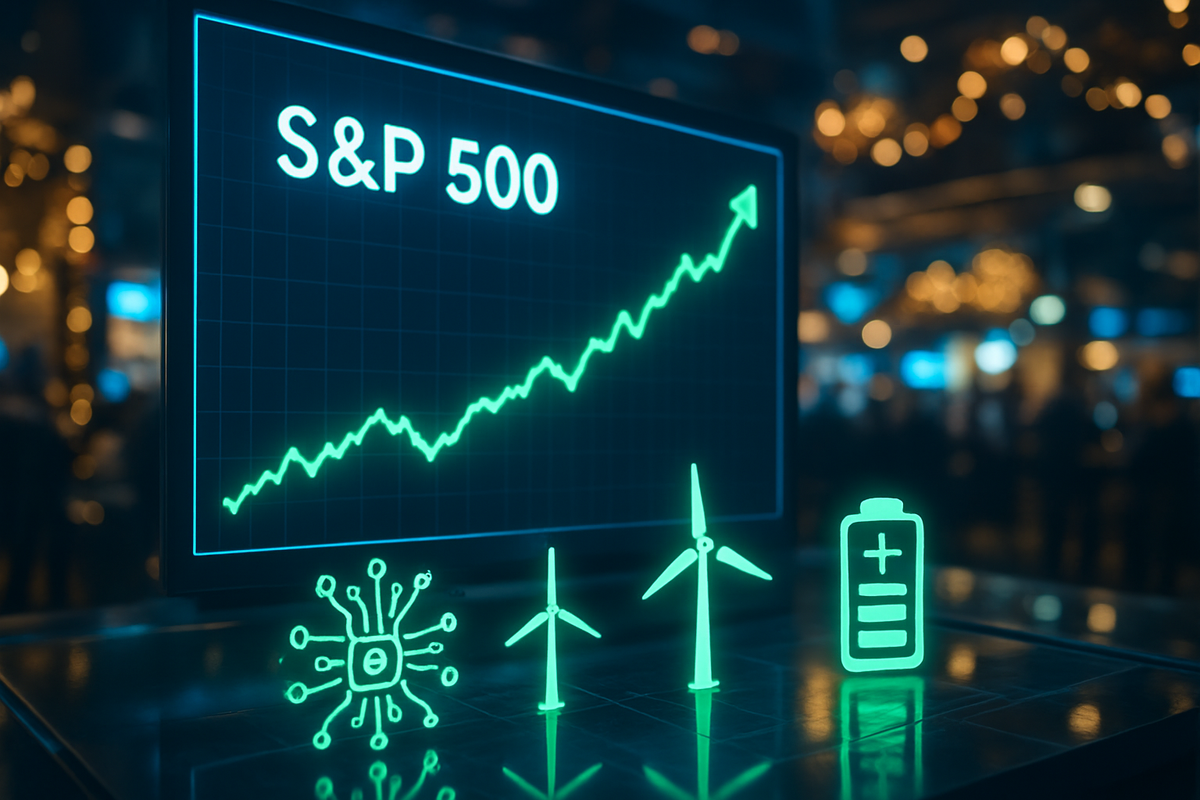
The U.S. equity markets continued their year-end ascent on Tuesday, December 23, 2025, as the S&P 500 (INDEXSP:.INX) notched its third consecutive winning session. This momentum, often referred to as the "Santa Claus Rally," was fueled by a confluence of robust economic data and a growing sense of relief among investors that the domestic economy remains on a solid footing despite persistent inflationary pressures. The benchmark index gained 0.20% to finish at 6,892.09, placing it within striking distance of its all-time closing high as the trading year winds down.
The immediate implications of this rally are significant for both institutional and retail investors. With the S&P 500 up approximately 18% for the year, the current surge suggests a high level of confidence in the 2026 outlook. However, the gains come amid a backdrop of "thin" holiday trading volumes, which can often exacerbate price swings. As the market heads into the final days of December, the primary focus has shifted from the fear of a hard landing to the management of a "no-landing" scenario, where growth remains high but interest rates stay elevated for longer than previously anticipated.
Resilience in the Face of Sticky Inflation
The trading session on December 23 was characterized by a "good news is good news" sentiment, even as economic reports presented a complex picture. The primary catalyst was a delayed third-quarter Gross Domestic Product (GDP) report, which revealed the U.S. economy grew at a staggering annualized rate of 4.3%. This figure far exceeded the consensus estimate of 3.2%, marking the fastest growth in two years. The surge was largely attributed to resilient consumer spending and a massive uptick in private domestic investment, particularly in the technology and energy infrastructure sectors.
However, the robust growth data was accompanied by a reminder of the Federal Reserve's ongoing battle with price stability. The Personal Consumption Expenditures (PCE) index—the Fed’s preferred inflation gauge—climbed to a 2.8% annual pace. This "stubborn" inflation reading, combined with the hot GDP print, led to a swift repricing of interest rate expectations. By the market close, the CME FedWatch tool indicated an 85% probability that the Federal Reserve would hold rates steady at its upcoming January meeting, a pivot from earlier hopes of a mid-winter cut.
The timeline leading to this moment was fraught with uncertainty. Earlier in the month, a brief federal government shutdown had delayed several key economic releases, leaving investors "flying blind" during the first two weeks of December. The release of the "catch-up" data this week acted as a pressure valve, releasing pent-up demand for equities as the uncertainty of the shutdown faded. Key stakeholders, including Cleveland Fed President Beth Hammack, signaled that a pause in rate cuts is now the "base case," citing the dilemma of strong growth potentially stoking further inflation.
Winners and Losers: The AI and Healthcare Divide
The year-end momentum has been unevenly distributed, creating clear winners in the technology and healthcare sectors while leaving traditional "Old Economy" stocks in the lurch. Nvidia Corp. (NASDAQ: NVDA) remained a primary beneficiary of the rally, rising as the company announced plans to resume high-end chip shipments to China by early 2026. This move alleviated fears of a prolonged revenue hit from trade restrictions and helped push Nvidia's valuation back toward the $5 trillion mark. Similarly, Alphabet Inc. (NASDAQ: GOOGL) saw gains after securing a multi-billion dollar deal with Intersect Power to provide clean energy for its expanding AI data center network.
In the healthcare space, Novo Nordisk (NYSE: NVO) emerged as a dominant force. The company's shares surged roughly 8% following the FDA's approval of a once-daily oral version of its blockbuster weight-loss drug, Wegovy. This milestone is expected to significantly expand the market for GLP-1 medications, further solidifying the sector's lead. Conversely, Eli Lilly and Co. (NYSE: LLY) also saw positive movement, as the "duopoly" in the weight-loss space continues to capture investor imagination and capital.
On the losing side, the "Consumer Staples" sector has faced a grueling 2025. Companies like PepsiCo, Inc. (NASDAQ: PEP) and Lamb Weston Holdings (NYSE: LW) have struggled as the widespread adoption of GLP-1 drugs began to show a measurable impact on snack and caloric beverage consumption. Additionally, the energy sector has seen a sharp divergence; while "AI Energy" plays like Vistra Corp. (NYSE: VST) have soared on nuclear power demand, traditional oil majors like Exxon Mobil Corp. (NYSE: XOM) have lagged due to a global supply glut that kept crude prices suppressed throughout the latter half of the year.
Broader Significance: The Great 2025 Revaluation
The current market wrap reflects a broader trend that has defined 2025: the revaluation of the U.S. economy as an AI-driven powerhouse. This shift has moved beyond software and into the physical world, creating a "Physical AI" trade that has boosted industrials and utilities. The fact that the S&P 500 has maintained its gains despite the "Liberation Day" tariff volatility in April and a government shutdown in December speaks to a fundamental resilience that many analysts did not predict at the start of the year.
Historically, the 2025 market bears a striking resemblance to the late 1990s, characterized by high productivity gains and a technology-led expansion. However, the 2025 version is tempered by a more cautious Federal Reserve and a more complex geopolitical landscape. The "Agentic Commerce" trend—where AI assistants manage consumer purchases—is starting to redefine the retail moat, favoring massive logistics players like Walmart Inc. (NYSE: WMT) and Amazon.com, Inc. (NASDAQ: AMZN) over smaller, discovery-based retailers who are struggling to adapt to the automated shopping era.
Furthermore, the decoupling of the "Energy" sector from "Oil" is a policy-relevant shift. Regulators and policymakers are now increasingly focused on grid stability and nuclear energy permits as a matter of national economic security. The ripple effects are being felt in the bond market as well, where the "higher for longer" narrative has kept the 10-year Treasury yield anchored above 4%, a level that would have traditionally pressured tech valuations but has been offset by the sheer scale of AI-related earnings growth.
Looking Ahead: The Final Countdown to 2026
As investors eye the final four trading sessions of 2025, several short-term factors will dictate the market's closing price. Tax-loss harvesting is largely complete, meaning the "selling pressure" on laggards may subside, potentially leading to a small bounce in beaten-down sectors like retail and traditional energy. Investors should watch for the "Santa Claus Rally" window, which technically covers the last five trading days of December and the first two of January. Historically, this period has a high probability of positive returns.
In the long term, the strategic pivot for 2026 will involve navigating the "No Landing" scenario. If GDP remains above 4% and inflation stays near 3%, the Federal Reserve may be forced to keep rates at restrictive levels for the entirety of the coming year. This would create a challenging environment for small-cap stocks, represented by the Russell 2000 (INDEXRUSSELL:RUT), which are more sensitive to borrowing costs. Conversely, the "Magnificent Seven" and their infrastructure partners are likely to remain the primary vehicles for growth as they leverage their massive cash piles to build out the next generation of the internet.
Market Wrap-Up and Investor Outlook
The S&P 500’s performance on December 23, 2025, serves as a fitting coda to a year defined by technological breakthroughs and economic hardiness. The key takeaways are clear: the U.S. consumer remains a formidable engine of growth, AI has moved from a speculative bubble to a fundamental driver of industrial demand, and the Federal Reserve is in no hurry to ease policy while the economy is running hot. The third-straight winning session provides a "cushion" for the market as it enters the low-liquidity holiday period.
Moving forward, the market is likely to remain in a "buy the dip" regime, though the bar for earnings surprises in 2026 will be significantly higher. Investors should keep a close watch on the January jobs report and the subsequent Fed meeting, as these will provide the first real clues as to whether the 2025 momentum can be sustained into the new year. For now, the "Santa Claus Rally" appears to be in full swing, rewarding those who stayed the course through a year of significant volatility and structural change.
This content is intended for informational purposes only and is not financial advice.