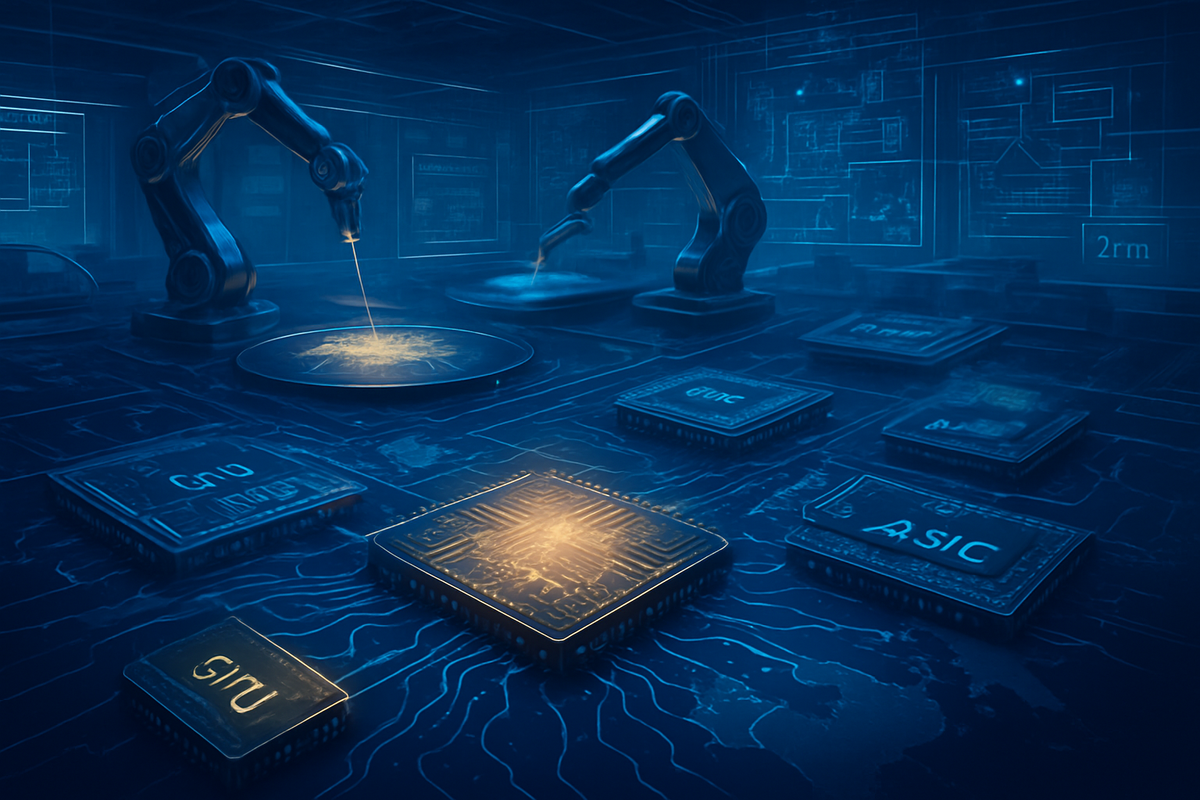
As the trading year of 2025 draws to a close, the semiconductor industry is witnessing a seismic shift in market leadership and investor sentiment. While Nvidia (NASDAQ: NVDA) dominated the headlines for much of the previous two years, today’s broad-based rally on December 22, 2025, signals a "great broadening" of the artificial intelligence trade. The Philadelphia Semiconductor Index (SOX) climbed 3.4% in early trading, fueled by a collective realization that the infrastructure requirements for 2026—the year many analysts are calling the "Year of the Agent"—will require a far more diverse ecosystem of silicon than previously anticipated.
The immediate implications of today’s market action are clear: investors are no longer just betting on the "brains" of AI, but on the entire skeleton, nervous system, and memory of the digital age. With global semiconductor sales now projected to surpass $1 trillion for the first time in 2026, the industry is transitioning from a period of speculative hype into a phase of structural expansion. Today’s surge was punctuated by a series of analyst upgrades across the networking, memory, and custom silicon sub-sectors, reflecting a market that is preparing for a massive $602 billion capital expenditure wave from the world’s largest hyperscalers.
The 2026 Infrastructure Wall
The rally today was catalyzed by a leaked consensus report suggesting that the "Big Five" hyperscalers—Microsoft (NASDAQ: MSFT), Alphabet (NASDAQ: GOOGL), Meta (NASDAQ: META), Amazon (NASDAQ: AMZN), and Oracle (NYSE: ORCL)—are planning a combined 36% year-over-year increase in infrastructure spending for 2026. This "wall of capex" is largely driven by the shift toward Agentic AI, which requires up to 100 times more compute power per task than the chatbots of 2024. As these companies race to build "Stargate"-class data centers, the demand for specialized hardware has moved beyond the GPU into high-speed networking and advanced thermal management.
The timeline leading to this moment has been a steady drumbeat of technological breakthroughs. Throughout 2025, the industry successfully navigated the transition to the 2nm manufacturing node and the standardization of HBM4 memory. Key players like Taiwan Semiconductor Manufacturing Company (NYSE: TSM) have spent the last quarter ramping up their N2 process, which is already reported to be sold out through mid-2026. This supply-side constraint has created a "scarcity premium" for any company capable of delivering high-end AI silicon, further driving today's price action.
Initial market reactions have been overwhelmingly positive, with mid-cap semiconductor firms and equipment manufacturers seeing the largest percentage gains. The industry is no longer waiting for "the next Nvidia"; instead, it is rewarding companies that provide the essential plumbing for the AI era. This includes firms specializing in silicon photonics and liquid cooling—technologies that were considered niche just 18 months ago but are now mandatory for the 2026 hardware cycle.
Winners and Losers in the New Silicon Order
Among the primary beneficiaries of today’s rally is Advanced Micro Devices (NASDAQ: AMD). As Nvidia transitions from its Blackwell architecture to the upcoming Rubin series, AMD has successfully carved out a significant portion of the hyperscaler market with its Instinct MI350 series. With the MI400 slated for a 2026 release, AMD is being viewed as the essential "second source" for AI chips, providing the price competition and supply diversity that cloud providers crave. Their stock outperformed the broader index today, reflecting growing confidence in their 2026 roadmap.
Broadcom (NASDAQ: AVGO) and Marvell Technology (NASDAQ: MRVL) also emerged as clear winners, as the market shifts focus to custom silicon (ASICs) and networking. Broadcom’s $73 billion backlog heading into 2026 highlights its dominance in helping companies like Google and Meta design their own internal AI accelerators. Meanwhile, Micron Technology (NASDAQ: MU) saw a significant bump as HBM4 memory becomes the primary bottleneck for AI performance. Analysts project that Micron’s revenue could grow by 50% in 2026 as the memory-to-compute ratio in AI servers continues to climb.
On the other side of the spectrum, Intel (NASDAQ: INTC) continues to face a skeptical audience. While its 18A process has officially entered mass production, the company is still struggling to regain the foundry leadership necessary to compete with TSMC. Although Intel’s stock rose slightly in sympathy with the sector, it lagged behind its peers as investors wait for concrete evidence that its "AI-everywhere" strategy can translate into the high-margin server wins seen by its competitors.
A Structural Shift in Global Computing
The wider significance of today’s rally lies in the transition of AI from a software novelty to a sovereign priority. We are seeing the emergence of "Sovereign AI" clusters, where nations like Saudi Arabia, India, and Japan are investing billions to build domestic computing power. This creates a secondary layer of demand that is less sensitive to the capital expenditure cycles of US-based tech giants. This trend mirrors the historical precedent of the telecommunications buildout in the late 1990s, but with a crucial difference: the utility of AI infrastructure is being realized almost as fast as it is being built.
Furthermore, the shift toward the "edge" is beginning to take hold. As 2026 approaches, the industry is preparing for a world where AI isn't just processed in massive data centers but on local devices. This has revitalized companies like ARM Holdings (NASDAQ: ARM), whose energy-efficient architectures are becoming the blueprint for the next generation of AI-enabled PCs and smartphones. The regulatory environment is also evolving, with updated CHIPS Act incentives focusing more on advanced packaging and the "back end" of the supply chain, ensuring that the infrastructure push is geographically diversified.
The ripple effects of this surge extend beyond silicon. The massive power requirements of 2026-era AI clusters have turned electrical equipment providers and power management firms into honorary semiconductor stocks. Companies like Vertiv Holdings (NYSE: VRT) are now integral parts of the semiconductor conversation, as the industry realizes that the limit to AI growth is no longer just chip speed, but the ability of the power grid to support it.
The Road to 2026 and Beyond
Looking ahead, the short-term focus will remain on the execution of the 2nm ramp-up. Any delays in TSMC’s production schedule could send shockwaves through the market, given how much of the 2026 "supercycle" is predicated on this technology. Strategic pivots are already underway; Nvidia is moving toward a "system-level" sales model, selling entire server racks rather than individual chips, a move that forces competitors to either follow suit or find specialized niches.
The long-term challenge will be the potential for "capex fatigue" among hyperscalers. While the 2026 projections are robust, the market will eventually demand to see the return on investment (ROI) from the trillions spent on infrastructure. If Agentic AI fails to deliver the productivity gains promised, a significant market correction could occur in late 2026 or 2027. However, for the moment, the momentum is firmly on the side of the builders, with new market opportunities emerging in areas like optical interconnects and bio-inspired computing.
Summary of the Silicon Surge
Today’s broad-based rally marks the end of the "Nvidia-only" era and the beginning of a multi-polar semiconductor market. The key takeaway for investors is that the AI trade has matured; it is now an infrastructure play that encompasses memory, networking, and custom design. The $1 trillion market milestone is no longer a distant dream but a 2026 reality that is being priced in today.
Moving forward, the market will likely remain volatile but biased toward the upside as we enter the first quarter of 2026. Investors should keep a close watch on quarterly earnings reports from the major hyperscalers in January, as these will provide the final confirmation of the 2026 spending plans. The lasting impact of this event is the solidification of semiconductors as the most critical commodity in the global economy, surpassing even oil in its strategic and financial importance.
This content is intended for informational purposes only and is not financial advice.