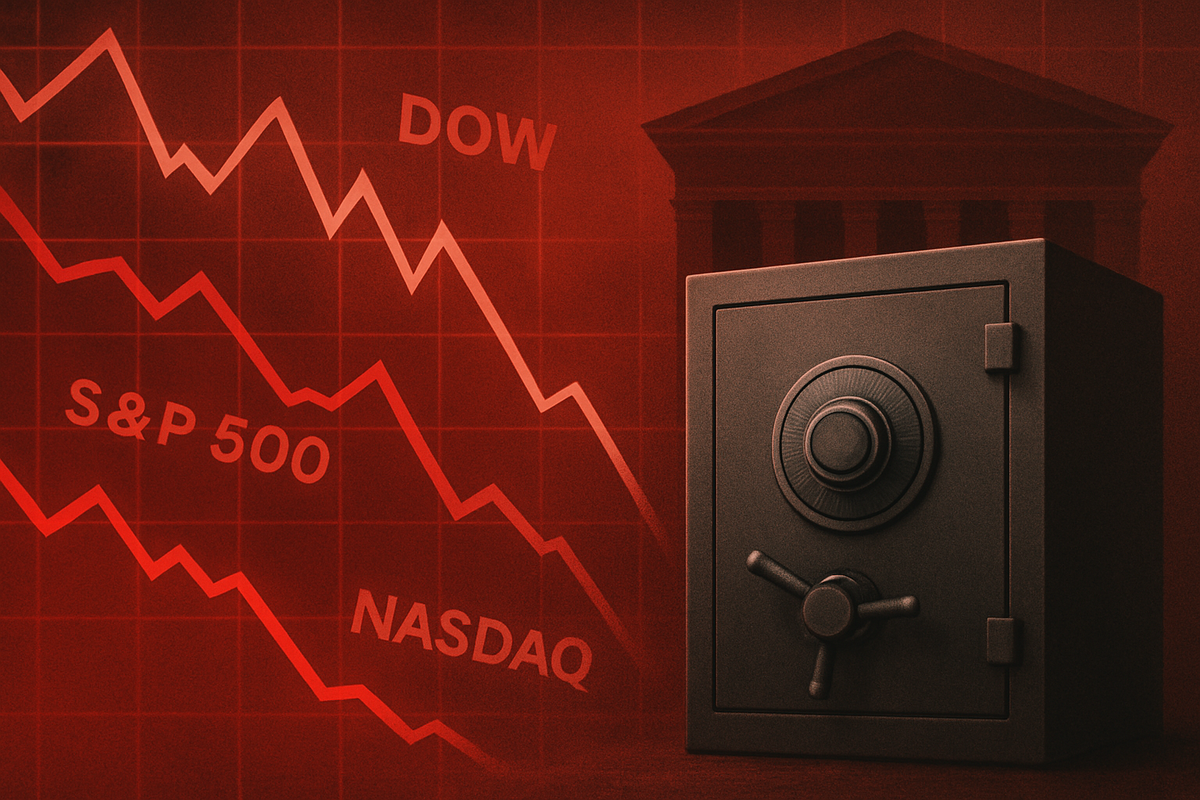
The financial markets have opened December on a cautious note, experiencing a notable downturn that has seen major indexes—the Dow Jones Industrial Average (DJIA), S&P 500, and Nasdaq Composite—all retreat. This sudden shift marks a stark contrast to the robust rebound witnessed throughout November, signaling a pervasive "risk-off" sentiment among investors. The immediate implications include widespread profit-taking and portfolio rebalancing, as market participants reassess their exposure to risk amid growing uncertainties.
This downturn reflects a collective pivot away from speculative growth assets towards more stable, capital-preserving investments. After a period of strong performance, particularly at the close of November, investors are cashing in on gains, contributing to the selling pressure. This systematic de-risking suggests that while November offered a much-needed reprieve, underlying concerns about the economic landscape and future market trajectory continue to loom large.
Unpacking the "Risk-Off" Shift: A Confluence of Concerns
The sudden onset of "risk-off" sentiment at the start of December can be attributed to a complex interplay of economic, geopolitical, and policy-related factors, collectively prompting investors to prioritize caution. This shift in market psychology often follows a period where optimism may have outpaced fundamental realities, leading to a re-evaluation of asset valuations.
Economically, concerns about weakening global growth persist. Recent disappointing economic indicators, such as manufacturing data or consumer confidence reports, may have signaled a potential slowdown or even recessionary pressures, triggering investor apprehension. Additionally, if corporate earnings forecasts have softened or valuations in certain high-growth sectors, particularly technology, are perceived as stretched, it can fuel a sell-off. Geopolitical tensions, whether ongoing conflicts or new flashpoints, invariably introduce uncertainty, compelling investors to seek safe havens. Policy-wise, any hawkish signals from central banks, such as hints of sustained higher interest rates or a reduction in accommodative monetary policies, can tighten financial conditions and dampen investor enthusiasm for riskier assets.
The build-up of such sentiment can sometimes be gradual, emerging from a series of worsening news cycles, or it can manifest abruptly due to a singular, impactful event. Typically, the initial stages involve increased market volatility, often reflected in a rising VIX index. As caution grows, capital flows from equities, commodities, and high-yield bonds into traditional safe havens like government bonds, gold, and defensive currencies. This widespread reallocation leads to broad market declines, with growth-heavy indexes like the Nasdaq Composite often experiencing the most significant impact due to their concentration in more speculative, high-valuation stocks. Stakeholders, from individual investors to large institutional funds, react by rebalancing portfolios, reducing exposure to volatile assets, and scrutinizing upcoming economic data and central bank communications for clues on future market direction.
Winners and Losers in a Risk-Off Environment
A "risk-off" market environment creates a clear divergence in performance across different sectors and public companies, as investors abandon growth-oriented strategies in favor of capital preservation.
Companies in defensive sectors typically fare better, demonstrating resilience due to the inelastic demand for their products and services. These include Consumer Staples, such as Procter & Gamble (NYSE: PG) or Coca-Cola (NYSE: KO), whose everyday essentials remain in demand regardless of economic conditions. The Healthcare sector, encompassing pharmaceutical giants like Johnson & Johnson (NYSE: JNJ) and medical device manufacturers, also tends to be stable, as health needs are non-discretionary. Utilities providers, like Duke Energy (NYSE: DUK) or American Water Works (NYSE: AWK), offering essential services like electricity and water, are similarly resilient due to stable demand and often regulated pricing. These companies are characterized by stable cash flows, consistent dividends, and lower volatility, making them attractive during uncertain times. Precious metals miners, such as Barrick Gold (NYSE: GOLD), also tend to benefit as gold is a traditional safe-haven asset.
Conversely, cyclical and growth-oriented sectors are particularly vulnerable. Consumer Discretionary companies, including luxury brands like LVMH (EPA: MC) or automobile manufacturers like Ford (NYSE: F), suffer as consumers cut back on non-essential spending. The Technology sector, despite its long-term growth potential, often bears the brunt of risk-off sentiment. High-valuation tech giants like NVIDIA (NASDAQ: NVDA) or even established players like Amazon (NASDAQ: AMZN) can see significant declines as investors question stretched valuations and the impact of higher interest rates on future earnings. Financials, such as JPMorgan Chase (NYSE: JPM), can also be hit hard by reduced lending, increased loan defaults, and market volatility affecting their investment portfolios. Companies with high debt loads, sensitivity to interest rates, and business models predicated on continuous economic expansion are most at risk, as their revenues and profits are highly correlated with the overall economic cycle.
Broader Implications and Historical Parallels
The early December market downturn, fueled by a "risk-off" sentiment, carries wider significance beyond immediate portfolio adjustments. It signals a potential recalibration within broader industry and economic trends, often reflecting deeper anxieties about the global financial outlook. Such shifts can indicate a loss of investor confidence and a transition from a "risk-on" to a more sustained "risk-off" environment, aligning with concerns about economic slowdowns, persistent inflation, or escalating geopolitical tensions. The interconnectedness of global markets means that such sentiment can quickly ripple across different economies and asset classes.
The ripple effects are far-reaching. Defensive sectors, as noted, tend to offer stability, while cyclical and growth sectors face significant pressure. Financial institutions may see reduced lending and increased defaults, impacting their profitability. Supply chains, already fragile, could face further disruptions due to reduced demand and inventory adjustments. Companies reliant on highly impacted sectors, such as semiconductor manufacturers supplying the tech industry, might experience modulated demand. Regulatory and policy responses are often swift during periods of significant market volatility. Central banks typically consider monetary policy interventions, such as interest rate adjustments or quantitative easing, to stabilize markets. Governments may implement fiscal stimulus measures to counter economic slowdowns. There is often increased scrutiny on market stability and calls for regulatory reforms to prevent future instability.
Historically, market downturns driven by "risk-off" sentiment are not new. The Dot-Com Bubble burst (2000-2002) serves as a direct precedent for concerns about overvalued tech assets. The Global Financial Crisis (2008) highlighted systemic risk and the dangers of interconnected financial systems. Even the COVID-19 pandemic (2020) demonstrated how external shocks can trigger rapid sell-offs and a flight to safety, followed by extensive fiscal and monetary interventions. These historical events consistently underscore that market downturns are integral to economic cycles, emphasizing the role of investor psychology, global financial interconnectedness, and the inevitable need for coordinated policy responses.
What Comes Next: Navigating the Uncertainty
Following a market decline driven by "risk-off" sentiment, the path forward is typically characterized by continued caution and selective investment, though opportunities can emerge for discerning participants. In the short term, markets are likely to remain volatile, with sustained downward pressure on cyclical and growth-oriented sectors. The "flight to safety" will likely continue, bolstering assets like government bonds, gold, and defensive stocks. Liquidity may also tighten, potentially impacting corporate expansion and challenging highly indebted companies.
Looking further ahead, several long-term possibilities exist. A gradual market recovery, albeit with persistent volatility, is a common scenario, especially if inflation subsides and central banks adopt a more accommodative stance. Conversely, prolonged stagflation could emerge if high inflation persists alongside geopolitical tensions. Historically, markets have always recovered from downturns, presenting opportunities for long-term investors to acquire quality assets at discounted prices.
Companies will need to strategically pivot, prioritizing liquidity and capital preservation through meticulous cash flow monitoring and cost-cutting. Enhancing operational agility and diversifying revenue streams will be crucial for navigating uncertain economic conditions. For investors, reallocating towards safer assets, maintaining a diversified portfolio, and adopting a long-term perspective with strategies like dollar-cost averaging can help weather the storm. Opportunities may arise in undervalued assets and defensive sectors, while challenges include persistent volatility, recession fears, and geopolitical risks. The market's trajectory in the coming months will hinge on central bank actions, inflation trends, corporate earnings, and geopolitical developments, with potential scenarios ranging from a fragile recovery to a deeper correction or, optimistically, a gradual improvement driven by positive economic shifts.
Comprehensive Wrap-up: A Test of Resilience
The early December market decline, stemming from a pronounced "risk-off" sentiment, serves as a potent reminder of the inherent cyclicality and unpredictability of financial markets. It underscores that even after a strong rebound, underlying vulnerabilities can quickly shift investor focus from growth to capital preservation. The key takeaway is the paramount importance of market sentiment, which can rapidly drive capital flows into safe-haven assets and away from riskier ventures, impacting major indexes like the Dow, S&P 500, and Nasdaq.
Moving forward, the market outlook remains one of continued caution and selective engagement. While historical patterns suggest eventual recovery, the pace and nature of that recovery will be heavily influenced by the trajectory of inflation, the responsiveness of central bank policies, and the evolution of geopolitical events. Companies that demonstrate strong balance sheets, operational agility, and a focus on essential goods and services are likely to prove more resilient.
For investors, this period is a test of discipline and strategic foresight. Avoiding emotional decisions, maintaining a well-diversified portfolio, and adhering to a long-term investment plan are crucial. What investors should watch for in the coming months includes key economic indicators (GDP growth, unemployment, consumer confidence), central bank communications regarding interest rates, corporate earnings reports and guidance, and shifts in market volatility (e.g., the VIX index). Observing capital flows and credit market spreads can also provide early signals of a potential return to "risk-on" sentiment. Ultimately, this downturn, while challenging, reinforces the timeless principles of prudent investing and the enduring resilience of the market over time.
This content is intended for informational purposes only and is not financial advice