If you have printed a QR Code on a menu, a package, or a poster in the last few years, there is a good chance it was a dynamic one, even if you never used the word. Dynamic QR Codes are the version businesses reach for because they solve the two problems that make static codes frustrating: you cannot change a static code once it is printed, and you cannot tell whether anyone scanned it. This guide explains what dynamic codes are, where they earn their place in a business, and how to pick the tool that fits how you actually work.
What is a dynamic QR Code?
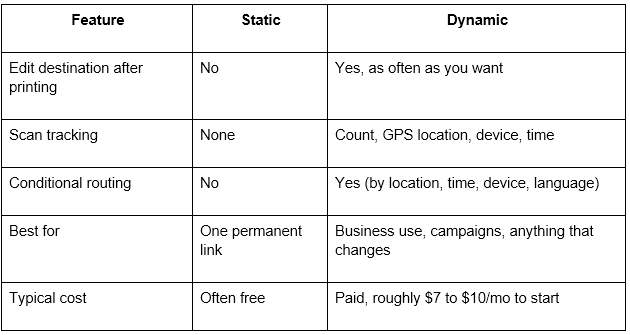
A dynamic QR Code encodes a short redirect link rather than the final destination. When someone scans it, that link quietly forwards them to whatever page you have set, and because you control the link, you can change the destination whenever you like without touching the printed code. A static QR Code works differently: it encodes the destination directly into the pattern, so the only way to change where it goes is to generate a new code and reprint it.
That single design difference is why dynamic codes dominate business use. A static code is fine for something that will never change, like a link to a permanent homepage. The moment a price, a promotion, or a landing page might move, or the moment you want to know how many people scanned and where, a static code stops being enough. A dynamic code turns a printed asset into something you can edit and measure for as long as it is in the field.
Static vs dynamic QR Codes at a glance
Why businesses choose dynamic QR Codes
The appeal comes down to a handful of practical gains, and they compound once you are running more than a code or two.
The first is that you can fix things without reprinting. Imagine a regional coffee chain with a dozen locations that prints a menu code on every table tent. Prices shift with the seasons, a supplier changes, a drink gets discontinued. With static codes, each of those changes would mean designing, printing, and distributing new table tents to twelve cafés. With a dynamic code, the code on the table stays the same and the manager updates the menu behind it from a dashboard in a couple of minutes. The printed material outlives the changes instead of being thrown away with them.
The second gain is measurement. Every scan of a dynamic code is recorded with its count, GPS location, device, and time, so a poster or a package becomes a channel you can actually attribute rather than a hopeful guess. Many tools push that data into Google Analytics, so QR performance sits next to the rest of your traffic instead of in a silo. For that same coffee chain, scan data quickly reveals which locations lean on the digital menu and which barely touch it, which is the kind of insight that changes where you focus.
The third is flexibility in where a single code sends people. With conditional routing, one code can open a different page depending on the scanner's location, the time of day, their device, or their language. A national brand can print one code on packaging and still send shoppers in different regions to region-specific pages, or route a lunchtime scan to a lunch menu and an evening scan to a dinner menu, all without creating separate codes.
The fourth is scale. When you need a code for every product, badge, or location, bulk creation generates them from a spreadsheet in a single pass, up to 2,000 at a time in a tool like Uniqode, rather than building them one by one. For a business tagging an inventory or printing event badges, that is the difference between an afternoon and a week.
Where dynamic QR Codes pay off
The pattern across use cases is the same: the destination or the audience changes over time, and a static code cannot keep up.
In restaurants and hospitality, the menu code is the obvious case, updated as prices and dishes change and split by daypart or location. In marketing, a code on a poster or mailer can be redirected mid-campaign, so a launch page becomes an evergreen page later while the scan data shows whether the placement worked. On product packaging, a code can carry a promotion at launch and shift to a reorder or support page afterward, and for food, beverage, and healthcare it can be a GS1 code that also encodes batch and expiry data for traceability. At events, bulk creation gives every badge a unique code, and a form behind the scan captures leads or feedback without paper. In retail and any multi-location business, one code can quietly serve many stores, seasons, or languages. Real estate agents lean on the same idea, updating a yard-sign code the moment a listing sells or drops in price, and capturing open-house sign-ins through a form.
How to choose a dynamic QR Code tool for your business
The right tool depends less on who has the longest feature list and more on what you are optimizing for. Three needs cover most businesses, and they point to different choices.
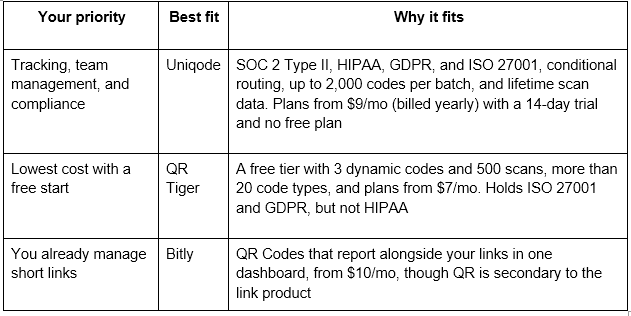
A few situations settle the decision quickly. If you work in a regulated field like healthcare or finance, compliance does the narrowing for you, because most tools hold GDPR and some hold ISO 27001, but few carry HIPAA, and that gap tends to be non-negotiable. If you are testing the idea with no budget, start on a free tier and upgrade once you know you will use it. And if short links are already central to your marketing, keeping codes in the same place you manage links is simpler than bringing in a separate tool for them.
What to check before you commit
A short due-diligence pass saves grief later. Confirm how long the tool keeps scan history, since short retention quietly makes year-over-year comparison impossible. Check that destination edits are unlimited on your plan rather than capped, and that your codes keep working if you downgrade or cancel, so a printed run does not suddenly go dead. If you generate at volume, make sure the per-batch limit fits your needs. And look for named, audited certifications such as SOC 2 Type II, ISO 27001, or HIPAA rather than a vague promise of security, because an audited standard is verified by a third party and a claim is not.
Frequently asked questions
What is a dynamic QR Code?
A dynamic QR Code points to an editable short link rather than a fixed destination, so you can change where it leads after printing and track every scan. A static code has a fixed destination that cannot be edited or tracked, which is why business use almost always calls for dynamic.
Are dynamic QR Codes free?
Rarely in full. Some tools include a small number of dynamic codes on a free tier, such as QR Tiger's three, but ongoing dynamic use is a paid feature, usually starting around $7 to $10/mo. Uniqode has no free plan and instead offers a 14-day trial, with plans from $9/mo.
Do dynamic QR Codes expire?
The code itself does not expire, but some tools stop the redirect or cap scans if you downgrade or cancel a plan. Choose a tool that keeps your codes and their data active for as long as you are on your plan, so nothing you have printed goes dead unexpectedly.
Can one dynamic QR Code link to different pages?
Yes. With conditional routing, a single code can open a different destination based on the scanner's location, the time of day, their device, or their language, which lets one printed code serve many audiences at once.
Which dynamic QR Code tool is best for business?
It depends on your priority. For tracking, team management, and compliance, Uniqode is the strongest, with HIPAA and SOC 2 Type II and plans from $9/mo. QR Tiger is the best low-cost start thanks to its free tier, and Bitly suits teams already managing short links.