As blockchain evolves from digital currency toward AI, RWA, GameFi, DeFi, and the global digital economy, what the market truly needs is no longer just another “slightly faster” public chain.
Instead, it requires a new-generation infrastructure capable of simultaneously addressing:
Performance, scalability, low cost, developer accessibility, and the ability to support large-scale applications.
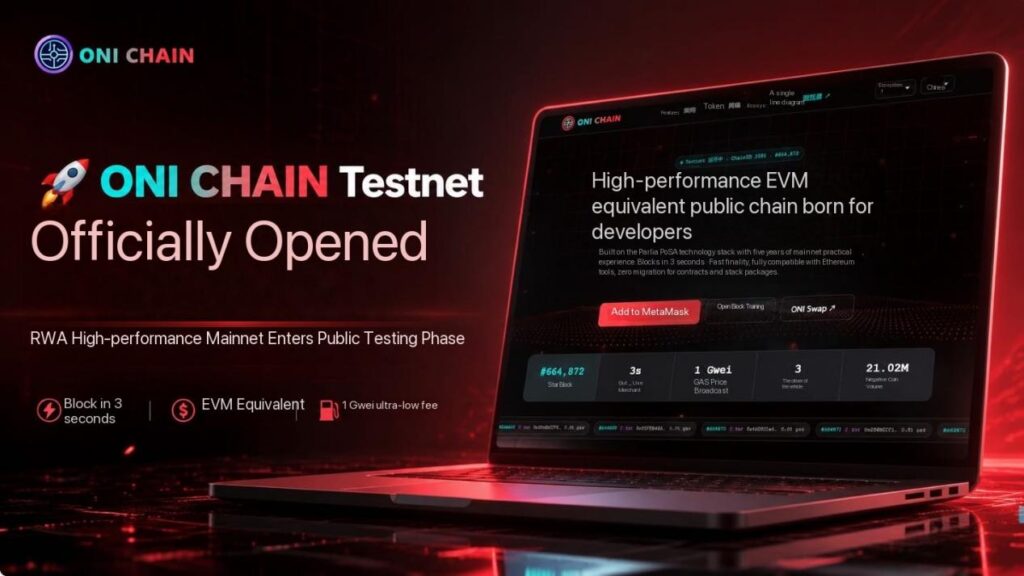
ONI Chain is proposing a fourth-generation high-performance mainnet architecture based on the core philosophy of being “Wider, Faster, and Stronger.”
01|From BTC to ETH, and Then to High-Performance Public Chains
If the development of blockchain is simply divided into several stages:
First Generation: Bitcoin
Solved the problems of accounting, storage, and peer-to-peer transfer of digital value.
Second Generation: Ethereum
Advanced blockchain from a “digital ledger” into a “smart contract platform,” enabling developers to build applications directly on-chain.
Third Generation: High-performance public chains such as Solana
Further addressed transaction speed and cost issues, allowing blockchain to evolve toward large-scale application infrastructure.
What ONI aims to enter is the next stage:
Fourth Generation: High-Performance Mainnet
The core is not simply pursuing “greater speed,” but rethinking blockchain architecture from the ground up:
How can blockchain achieve broader computing capacity, higher concurrency, lower usage costs, and an open application infrastructure designed for the AI era?
02|ONI’s Core Keyword: More Roads
ONI summarizes its technical roadmap through three key concepts:
Wider
Through parallel computing and parallel execution mechanisms, ONI improves the overall utilization of network computing resources.
Traditional blockchains require many transactions to be executed sequentially.
ONI aims to enable parallel processing of transactions without state conflicts, thereby overcoming efficiency limitations caused by single-threaded execution.
Faster
ONI sets high TPS capability as a key objective of its underlying architecture.
The design goal targets:
A high-performance network capability at the level of 100,000+ TPS.
It should be emphasized that this represents a network architecture objective and stress-testing benchmark. Actual performance will need to be verified through public testnet and mainnet testing results.
Stronger
ONI is not designed only to serve traditional DApps.
Its infrastructure design further targets emerging application scenarios including:
AI + RWA + GameFi + DeFi + SocialFi + Large-scale DApps
and other next-generation applications.
03|Four Core Technology Directions
ONI’s technology system is built around four core directions:
Parallel Computing
Parallel Computing Engine
Through technologies such as parallel execution, OCC, and MVCC, ONI improves transaction processing efficiency.
High Performance
High-Performance Network
High-Performance Network
Designed for high throughput, low latency, and large-scale concurrent applications.
Ultra-Low Gas
Extremely Low Usage Cost
By improving the network’s processing capacity per unit of time, ONI reduces the cost of individual application interactions.
AI Modularization
AI Modularization
Provides infrastructure interfaces for AI Agents, intelligent on-chain applications, and the future machine economy.
Ultimately forming:
Performance × AI × Open Network
An infrastructure ecosystem.
04|ONI Is Not Built Only for Users
Traditional public chain competition often focuses on:
“Whose TPS is higher?”
However, what truly determines whether a public chain can build a long-term ecosystem is:
Whether developers are willing to join.
Therefore, ONI proposes:
Open Network
An open network designed for developers.
Developers can deploy on ONI:
DApp
↓
DeFi
↓
GameFi
↓
AI Agent
↓
RWA
↓
SocialFi
↓
More future applications
ONI aims to become:
An open value network built for developers.
05|ONI Mainnet Economic Model
ONI adopts a fixed issuance mechanism.
Total Supply: 21,020,000 ONI
Design principle:
The network does not rely on unlimited issuance to maintain operation.
Network usage generates Gas.
Gas enters the network’s economic cycle.
Among these mechanisms, part of the system is used for ecosystem and network participant incentives, while a burning mechanism creates a long-term supply reduction model.
Ultimately forming:
Usage ↑
↓
Gas Demand ↑
↓
Ecosystem Value Capture ↑
↓
Burning Mechanism Activated
↓
Circulating Supply Decreases
↓
Enhanced Value of Network Participation
This forms the:
Value Flywheel
that ONI aims to establish.
06|ONI Node System
ONI will build a multi-layer global infrastructure node system.
The core components include:
Global Infrastructure Station
Responsible for global network infrastructure, regional ecosystem coordination, and node development.
Community Validator
Community validation nodes
Further expanding participation across the network.
Community
Ordinary users, developers, and ecosystem builders together form the application layer of the network.
Ultimately creating:
Infrastructure → Validator → Community → Developer → Application → User → Network Value
A complete ecosystem loop.
07|Why Now?
Over the past decade, blockchain has solved:
“How can digital assets exist?”
The next stage needs to solve:
“How can digital value flow at massive scale?”
Today, AI, RWA, blockchain gaming, digital identity, and on-chain finance are generating increasing demand for blockchain infrastructure.
What the future truly needs to support is no longer just transfers between wallets.
It may include:
Transactions between AI Agents.
Payments between robots.
Transfers of gaming assets.
On-chain settlement of real-world assets.
Automated settlement for global digital commerce.
This means:
Blockchain infrastructure must undergo another major upgrade.
08|What Does ONI Aim to Build?
ONI does not aim to become “just another ordinary public chain.”
It aims to build:
Next Generation Value Infrastructure
The next-generation digital value infrastructure.
Providing:
AI, RWA, GameFi, DeFi, SocialFi
and more future applications,
with a wider, faster, lower-cost, and more open underlying network.
09|ONI’s Long-Term Strategy
ONI’s development direction extends beyond mainnet launch.
The future ecosystem will expand around:
Mainnet → DEX → O Wallet → AI → RWA → GameFi → DApp → Global Nodes → Developer Ecosystem
Continuously expanding toward:
ONI Chain Ecosystem
10|The True Meaning of the Fourth-Generation Mainnet
If:
Bitcoin gave digital value internet-level scarcity for the first time;
Ethereum gave digital value programmability;
High-performance public chains enabled digital value to begin achieving large-scale circulation;
Then ONI aims to further solve:
How can large-scale digital value networks truly support the future world?
This is the core logic behind ONI’s positioning as:
“The Fourth-Generation Mainnet.”
ONI CHAIN
More Roads.
Wider Roads.
Stronger Network.
Broader · Faster · Stronger
The next-generation high-performance value infrastructure.
The Future Value Network Starts Here.