By: Finterra Research
Date: April 1, 2026
Introduction
Intel Corporation (NASDAQ: INTC) stands today at the most significant crossroads in its 58-year history. For decades, Intel was synonymous with the heart of the personal computer and the soul of the data center. However, the early 2020s were unkind to the Santa Clara giant, marked by manufacturing delays, market share erosion to Advanced Micro Devices (NASDAQ: AMD), and a late start in the artificial intelligence (AI) gold rush dominated by NVIDIA (NASDAQ: NVDA).
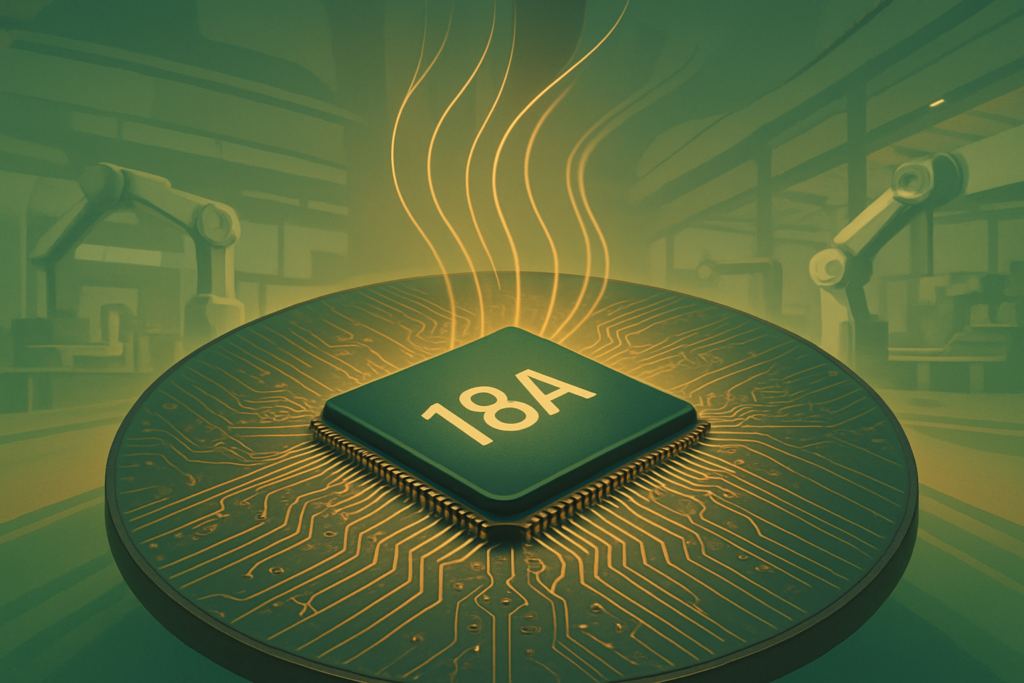
As of April 2026, the narrative has shifted from "survival" to "execution." Under the fresh leadership of CEO Lip-Bu Tan—who took the helm in early 2025—Intel has reorganized into two distinct operating entities: Intel Products and Intel Foundry. With the high-volume ramp of its 18A process node and a massive recovery in its stock price from 2025 lows, Intel is attempting to prove it can be both a world-class chip designer and the Western hemisphere’s premier alternative to Taiwan Semiconductor Manufacturing Company (NYSE: TSM).
Historical Background
Founded in 1968 by Robert Noyce and Gordon Moore (of Moore’s Law fame), Intel pioneered the semiconductor industry. Its transformation from a memory chip company to the king of the microprocessor under Andy Grove’s "Only the Paranoid Survive" mantra defined the PC era.
However, the "tick-tock" model that ensured Intel’s dominance began to crack in the 2010s. Persistent delays in the 10nm and 7nm process nodes allowed competitors like AMD and Apple (NASDAQ: AAPL) to leapfrog Intel’s performance using TSMC’s superior manufacturing. The return of Pat Gelsinger as CEO in 2021 launched the "IDM 2.0" strategy—a bold plan to open Intel’s factories to outsiders. While Gelsinger laid the groundwork and secured massive government support, he stepped down in December 2024 amid continued financial volatility, leaving Lip-Bu Tan to manage the crucial 2025-2026 delivery phase.
Business Model
Intel’s business model is now a "House of Two Rooms."
- Intel Products: This segment includes the Client Computing Group (CCG), which sells processors for PCs; the Data Center and AI (DCAI) group, focused on Xeon processors and Gaudi accelerators; and the Network and Edge (NEX) division.
- Intel Foundry: This is a standalone business unit designed to act as a contract manufacturer for the world. It provides "systems foundry" services—not just making the chips, but offering advanced packaging and software tools.
This model aims to solve the conflict of interest inherent in Intel’s past; by separating the P&L, Intel Foundry can court competitors like NVIDIA or Qualcomm as customers without compromising their proprietary designs.
Stock Performance Overview
The journey of INTC stock over the last five years has been a volatile U-turn.
- 1-Year: Since April 2025, INTC has surged approximately 120%, rising from a multi-decade low of roughly $20 to its current level of $44.25. This rally was fueled by the successful power-on of the 18A node and better-than-expected AI PC sales.
- 5-Year: Despite the recent recovery, the stock is still roughly 25% below its 2021 highs, reflecting the deep "lost years" of 2022-2024 where it underperformed the S&P 500 significantly.
- 10-Year: Long-term holders have seen modest capital appreciation, but the total return has been hampered by the suspension of the dividend in 2024 (which has yet to be fully reinstated) and the dilution from capital raises.
Financial Performance
Intel’s FY 2025 results, reported in early 2026, indicate a stabilizing ship.
- Revenue: $52.9 billion for FY 2025, showing resilience despite a shrinking legacy server market.
- Profitability: The company returned to non-GAAP profitability with an EPS of $0.42.
- Margins: Gross margins have clawed back to 39%, up from the sub-30% "danger zone" of mid-2025. However, they remain far below the 60% historical peaks as the company continues to spend heavily on new fabs.
- Debt/Cash Flow: Intel remains cash-hungry. CapEx for 2025 exceeded $25 billion, supported by CHIPS Act grants and strategic private placements from partners like NVIDIA and SoftBank.
Leadership and Management
The appointment of Lip-Bu Tan as CEO in March 2025 was a "credibility shock" to the market. Tan, the former CEO of Cadence Design Systems, is revered for his operational discipline. His strategy has been described as "ruthless prioritization"—slashing non-core R&D and focusing every dollar on ensuring the 18A and 14A nodes meet yield targets. The board, now heavily influenced by semiconductor veterans and institutional voices, has pivoted away from the broad-spectrum "Intel Everywhere" approach to a "Foundry First" reality.
Products, Services, and Innovations
Intel’s current product lineup is led by Panther Lake (Core Ultra Series 3), the first consumer chip built entirely on the 18A process. Launched in early 2026, it has solidified Intel’s 56% market share in the burgeoning "AI PC" segment.
In the data center, the Xeon 6 family remains the "workhorse" of the internet, though it now plays a supporting role as the primary host CPU for NVIDIA’s new Rubin-based AI servers. Meanwhile, the Gaudi 3 and 4 AI accelerators have carved out a niche in "efficient inference," offering a lower-cost alternative to NVIDIA for companies running large language models (LLMs) rather than training them from scratch.
Competitive Landscape
The competition remains fierce:
- TSMC (The Benchmark): While Intel’s 18A is competitive, TSMC’s N2 node (2nm) is also entering volume production. Intel’s edge currently lies in its early adoption of PowerVia (backside power delivery), a technical leap that TSMC won't match until late 2026.
- AMD (The Rival): AMD’s "Venice" EPYC chips, slated for later this year, threaten Intel’s server share. AMD currently holds ~30% of the x86 server market, up from single digits a decade ago.
- NVIDIA (The Partner/Competitor): Intel competes with NVIDIA in AI silicon (Gaudi) but is increasingly becoming a supplier through Foundry services and host CPUs.
Industry and Market Trends
Three trends dominate the 2026 landscape:
- Sovereign Silicon: Nations are increasingly funding domestic chip production to avoid reliance on East Asia. Intel is the primary beneficiary of this "national security" spending.
- The AI PC Transition: The PC market has transitioned from "standard productivity" to "local AI processing," requiring NPUs (Neural Processing Units) in every laptop.
- Heterogeneous Computing: Chips are no longer just CPUs; they are "systems-on-a-chip" (SoCs) combining CPU, GPU, and AI cores, where Intel’s packaging technology (Foveros) gives it a structural advantage.
Risks and Challenges
- Execution Risk: If Intel 18A yields do not reach the 75% threshold by late 2026, the Foundry business will struggle to be profitable.
- Capital Intensity: Intel is building billions of dollars worth of factories. Any slowdown in the global economy could leave it with massive underutilized capacity.
- Geopolitical Friction: Continued U.S. restrictions on chip exports to China limit a major revenue source for Intel’s legacy products.
Opportunities and Catalysts
- External Foundry Wins: A major contract announcement (e.g., Apple or Qualcomm committing to 18A/14A) would be the "holy grail" catalyst for the stock.
- Dividend Reinstatement: As cash flow stabilizes, a return to a dividend-paying model would attract income-seeking institutional funds.
- Secure Enclave: Intel’s $3 billion "Secure Enclave" contract with the U.S. government provides a high-margin, recession-proof revenue stream.
Investor Sentiment and Analyst Coverage
The sentiment on Wall Street has shifted from "Sell" to "Cautious Buy." Goldman Sachs recently upgraded the stock to a "National Champion" status, citing the strategic importance of Intel to Western supply chains. Institutional ownership has seen a "rotation," with the U.S. Government now a beneficial owner of ~8.4% through CHIPS Act equity-linked mechanisms, while traditional value investors are returning as the turnaround is validated.
Regulatory, Policy, and Geopolitical Factors
Intel is effectively an arm of U.S. industrial policy. The CHIPS Act has provided over $10 billion in direct funding and loans. However, this comes with strings attached: Intel is heavily restricted from expanding advanced capacity in China, and its operations are under constant scrutiny for "national security" compliance. In Europe, the EU Chips Act is supporting Intel’s massive fab projects in Germany, though those have faced delays until 2027.
Conclusion
Intel in 2026 is no longer the "broken" company of 2024. It is a leaner, more focused enterprise that has successfully closed the technology gap with TSMC for the first time in a decade. However, the transformation is not yet complete. Investors must watch 18A yield rates and the ability of Intel Foundry to sign non-captive customers. If Intel can prove its manufacturing prowess is back for good, the current $44 price point may look like a bargain; if it stumbles on execution again, the road back to $20 is a short one.
This content is intended for informational purposes only and is not financial advice.