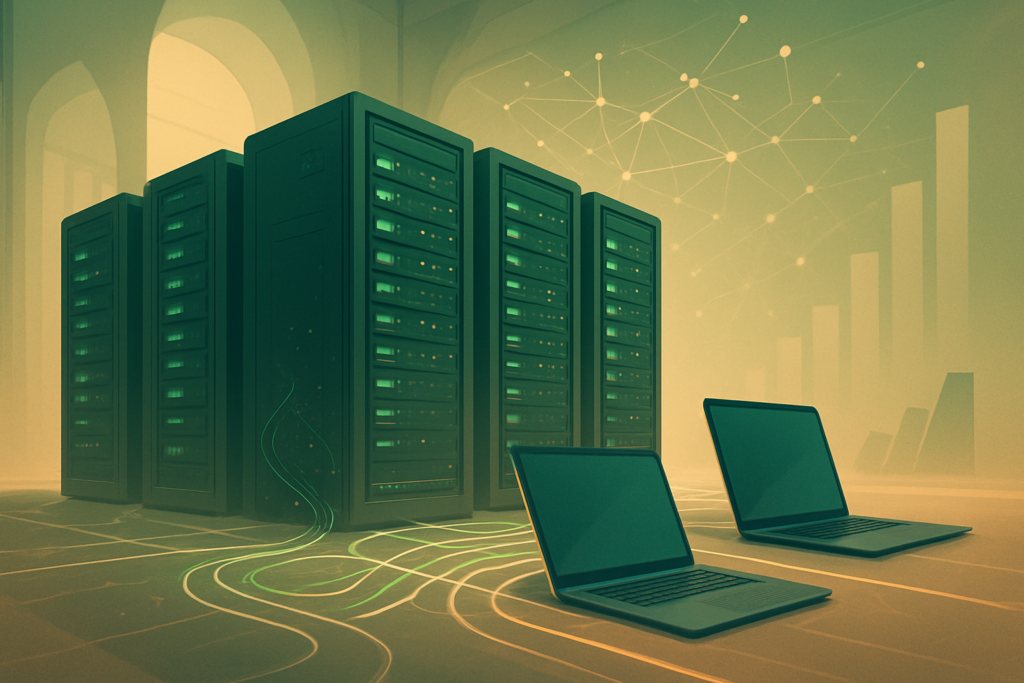
As of March 25, 2026, Dell Technologies Inc. (NYSE: DELL) has transcended its origins as a box-maker to become the primary architect of the global "AI Factory." Long perceived as a legacy hardware giant tethered to the cyclical fluctuations of the PC market, Dell is currently at the center of a generational shift in enterprise computing. With the explosive demand for generative AI (GenAI) and the massive infrastructure required to power it, Dell’s strategic pivot toward high-performance servers and end-to-end AI solutions has rewarded shareholders with record-breaking returns. Today, the company stands as a bellwether for the "Intelligence Age," balancing a massive AI server backlog with a high-margin premium PC business.
Historical Background
The Dell story is one of the most storied in American corporate history, beginning in 1984 when a 19-year-old Michael Dell founded "PC's Limited" in his University of Texas dorm room with just $1,000. By pioneering the "direct-to-consumer" model—eliminating the middleman and building computers to order—Dell disrupted the entire industry, becoming the world's largest PC maker by 2001.
However, the late 2000s brought challenges as mobile computing and cloud services shifted the landscape. In a bold and controversial move in 2013, Michael Dell partnered with Silver Lake Partners to take the company private in a $24.4 billion leveraged buyout. This "dark period" allowed the company to restructure away from the short-term pressures of Wall Street. In 2016, Dell completed the largest tech acquisition in history at the time, merging with EMC Corporation for $67 billion to gain dominance in data storage and virtualization (via VMware). Dell returned to public markets in late 2018, and after spinning off its stake in VMware in 2021, emerged as a leaner, infrastructure-focused powerhouse.
Business Model
Dell operates through two primary segments that create a synergistic hardware-and-services ecosystem:
- Infrastructure Solutions Group (ISG): This is the high-growth engine of the company. It provides traditional and AI-optimized servers, storage solutions, and networking hardware. ISG enables enterprises to build "AI Factories"—private data centers capable of training and running complex LLMs.
- Client Solutions Group (CSG): This segment includes commercial and consumer PCs, workstations, and peripherals. While CSG is more cyclical, it remains a cash-flow powerhouse. In 2026, the focus has shifted toward "AI-PCs," which command higher average selling prices (ASPs) due to integrated Neural Processing Units (NPUs).
Complementing these hardware segments is Dell's expanding APEX as-a-service model, which allows customers to consume compute and storage through a subscription-based, cloud-like experience on-premises.
Stock Performance Overview
Dell’s stock performance over the last five years has been nothing short of transformative. From 2021 to 2022, the stock was often valued as a "value play," trading in the $40–$60 range. However, the AI revolution that gained momentum in 2023 acted as a catalyst.
Over the last 12 months (leading up to March 2026), DELL shares have surged approximately 64%, recently hitting an all-time high of $176.91. This represents a more than 300% total return over the five-year horizon, vastly outperforming the S&P 500. The stock’s recent "breakout" is attributed to its massive AI server backlog and the successful execution of its "One Dell Way" operational strategy.
Financial Performance
For the fiscal year 2026 (which ended in January 2026), Dell posted record-breaking numbers. Total revenue reached $113.5 billion, a 19% increase year-over-year. The Infrastructure Solutions Group (ISG) was the standout performer, with AI-optimized server revenue alone accounting for $24.6 billion.
Key metrics from the latest reports include:
- Non-GAAP Diluted EPS: $10.30 (up 27% YoY).
- Operating Cash Flow: $11.2 billion, demonstrating high efficiency in converting revenue to cash.
- AI Server Backlog: A staggering $43 billion, providing high visibility for revenue in FY2027.
- Shareholder Returns: Dell recently increased its dividend by 20% and boosted its share repurchase authorization by $10 billion.
Leadership and Management
Michael Dell remains at the helm as Chairman and CEO, one of the few founders from the 1980s still leading a multi-billion dollar tech firm. His leadership is characterized by a "long-view" philosophy, evidenced by the 2013 privatization.
Supporting him is Vice Chairman and COO Jeff Clarke, who is credited with the operational discipline behind Dell’s supply chain excellence. The management team is currently focused on the "One Dell Way" initiative, an ambitious project to consolidate the company’s fragmented internal legacy systems into a single enterprise platform. This strategy is expected to streamline decision-making and improve margins by over 100 basis points by the end of 2026.
Products, Services, and Innovations
Dell’s current product portfolio is dominated by the PowerEdge XE9680, its flagship AI server designed for massive GPU clusters. These systems are optimized for the latest NVIDIA (NVDA) Blackwell architectures, providing the "compute density" required for modern data centers.
In the PC space, the "Copilot+" AI-PC line has redefined the Client Solutions Group. These laptops feature 40+ TOPS (Tera Operations Per Second) NPUs, allowing users to run AI models locally rather than in the cloud. Furthermore, Dell's R&D focus on liquid cooling technologies and edge computing (Project Frontier) has given it a competitive edge as data centers become more power-hungry and geographically dispersed.
Competitive Landscape
Dell faces a two-front war in its core markets:
- In Servers/Infrastructure: Its primary rivals are Super Micro Computer Inc. (NASDAQ: SMCI) and Hewlett Packard Enterprise (NYSE: HPE). While SMCI initially gained ground with its speed-to-market, Dell has benefited from a "flight to quality" in 2025 and 2026, as large enterprise customers favored Dell's superior global service and supply chain stability.
- In PCs: Dell competes with Lenovo and HP Inc. (NYSE: HPQ). Dell has largely ceded the low-margin consumer market to Lenovo to focus on the high-margin commercial/enterprise sector, where it currently leads in AI-PC adoption rates.
Industry and Market Trends
The "AI Infrastructure Build-out" remains the dominant trend. Enterprises are moving from the "experimental" phase of AI to "deployment at scale," which requires Dell’s high-performance hardware.
Additionally, the "Windows 10 End-of-Life" (October 2025) has triggered a significant corporate refresh cycle. As organizations replace aging fleets, they are increasingly opting for AI-ready PCs to "future-proof" their workforces. However, the industry is currently grappling with a "Memory Super-cycle," where a shortage of DRAM and SSDs has pushed component costs up by over 130%, a factor that could impact hardware margins across the sector in mid-2026.
Risks and Challenges
Despite the bullish momentum, several risks remain:
- Margin Compression: While AI server revenue is high, the competitive nature of large-scale GPU cluster bids can lead to thinner hardware margins.
- Component Supply: Dell’s ability to clear its $43 billion backlog is entirely dependent on the availability of high-end GPUs from NVIDIA and HBM (High Bandwidth Memory) from vendors like SK Hynix and Micron.
- China Exposure: As part of its "China Exit" strategy, Dell is aggressively removing Chinese-made chips from its enterprise products by late 2026. While this protects against geopolitical sanctions, the transition carries significant supply chain disruption costs.
Opportunities and Catalysts
- Sovereign AI: Dell is increasingly partnering with national governments in the Middle East and Southeast Asia to build domestic GPU clusters, a market that is less sensitive to traditional corporate budget cycles.
- Edge Computing: As AI moves from the data center to the "edge" (factories, retail stores, hospitals), Dell’s ruggedized Edge servers represent a multi-billion dollar expansion opportunity.
- One Dell Way: The May 2026 full launch of this internal efficiency project could serve as a major catalyst for margin expansion and earnings beats in the second half of the year.
Investor Sentiment and Analyst Coverage
Wall Street sentiment remains overwhelmingly positive. As of late March 2026, the consensus rating is a "Strong Buy." Analysts have lauded Dell’s "contracted infrastructure" model, noting that the massive backlog provides a floor for the stock price. Institutional investors, including major hedge funds, have increased their positions throughout 2025, viewing Dell as a more stable, diversified way to play the AI boom compared to "pure-play" AI startups.
Regulatory, Policy, and Geopolitical Factors
Dell is heavily impacted by US export controls on high-end AI technology. The company’s decision to move its supply chain out of China is a direct response to US policy aimed at securing critical infrastructure. On the domestic front, Dell is a beneficiary of various government initiatives to bolster US-based server manufacturing and domestic "AI Factories," positioning it as a key partner for federal agencies.
Conclusion
Dell Technologies (NYSE: DELL) enters the spring of 2026 in its strongest position since its founding. By successfully navigating the transition from a PC company to an AI infrastructure titan, it has secured a critical role in the global technology stack. While investors must remain wary of rising component costs and the complexities of a major supply chain shift away from China, the company’s massive backlog and the looming AI-PC refresh cycle suggest that the "Dell Renaissance" still has significant runway. For the discerning investor, Dell represents a rare combination of founder-led stability and high-octane growth potential in the most important secular trend of the decade.
This content is intended for informational purposes only and is not financial advice. Today's Date: March 25, 2026.