As of March 19, 2026, NIO Inc. (NYSE: NIO / HKEX: 9866 / SGX: NIO) has transitioned from a high-burn startup into a maturing, multi-brand automotive powerhouse. Once dubbed the "Tesla of China," NIO has spent the last decade carving out a unique identity centered on premium user experience and a revolutionary battery-swapping infrastructure. Today, the company finds itself at a critical inflection point: after years of skepticism regarding its capital-intensive business model, NIO recently reported its first quarterly net profit in late 2025. This feature explores how NIO navigated a brutal price war, international trade barriers, and internal restructuring to emerge as a leader in the global "Intelligence + EV" race.
Historical Background
Founded in November 2014 by serial entrepreneur William Li (Bin Li), NIO was born with the ambition to redefine the premium car segment. Backed early on by tech giants like Tencent and Baidu, the company made waves with its EP9 electric supercar, which shattered Nürburgring records. However, the journey was far from linear. In 2019, NIO faced a severe liquidity crisis, coming within weeks of bankruptcy before a critical $1 billion investment from the Hefei municipal government saved the firm.
This "Hefei bailout" proved to be a masterstroke, allowing NIO to scale its manufacturing and launch its Battery-as-a-Service (BaaS) model. Over the following years, NIO evolved from a single-brand luxury player into an ecosystem provider, weathering the COVID-19 pandemic and the 2023-2024 "Great Price War" in the Chinese EV market.
Business Model
NIO’s business model is built on three pillars: premium hardware, the "User Enterprise" philosophy, and energy-as-a-service.
- Multi-Brand Strategy: By 2026, NIO operates three distinct brands. The core NIO brand targets the luxury segment (RMB 300k+). The ONVO brand, launched in late 2024, targets the mass-market family segment (RMB 200k–300k). The Firefly brand focuses on premium compact cars for urban youth and international markets.
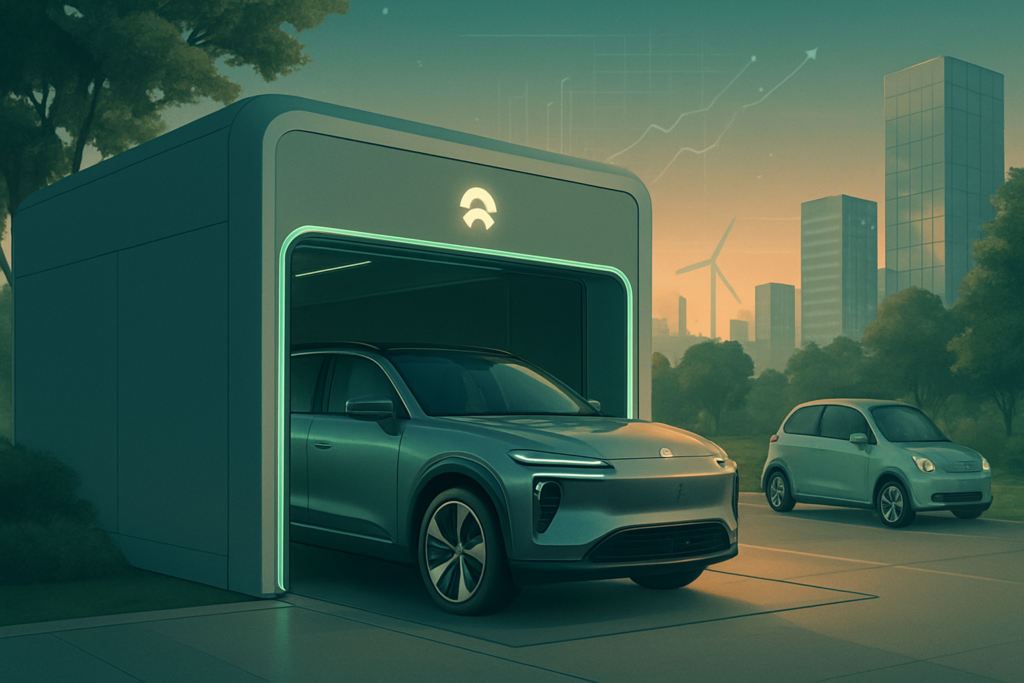
- Battery-as-a-Service (BaaS): This allows customers to buy the car without the battery, lowering the upfront cost and enabling 3-minute battery swaps. This is NIO’s primary competitive moat.
- Ecosystem Services: Beyond cars, NIO generates revenue through its "Nio Houses" (social clubs), Nio Life (merchandise), and the Nio Phone, which serves as a central hub for vehicle connectivity.
Stock Performance Overview
The stock performance of NIO has been a study in extreme volatility.
- 10-Year Horizon: From its 2018 IPO at $6.26, the stock skyrocketed to an all-time high of over $60 in early 2021 amid the EV mania.
- 5-Year Horizon: Since 2021, the stock entered a long-term bear market, bottoming out near $3.02 in 2024 as losses widened and competition intensified.
- 1-Year Horizon: Over the past 12 months, the stock has staged a recovery. Following the Q4 2025 earnings report which showed a surprise profit, shares surged. As of today, March 19, 2026, NIO is trading around $5.82, representing a significant bounce from its lows but still far below its historical peaks.
Financial Performance
Fiscal year 2025 was a landmark year for NIO. Total revenue reached RMB 87.49 billion ($12.51B), a 33% increase year-over-year. This growth was fueled by a record 326,028 deliveries, nearly 50% higher than the previous year.
Most significantly, the company posted a net profit of RMB 282.7 million in Q4 2025. Vehicle margins have stabilized at 18.1%, thanks to the cost efficiencies of the NT3.0 platform and the scaling of the ONVO sub-brand. While the full year 2025 still showed a net loss, management has guided for a total company breakeven in 2026, a target analysts now view as achievable.
Leadership and Management
Founder and CEO William Li remains the visionary heart of the company. Known for his "User Enterprise" mantra, Li has successfully maintained high brand loyalty despite aggressive pricing from competitors. Alongside President Lihong Qin, the leadership team has shifted focus from "growth at all costs" to "high-quality growth."
In 2025, the management team underwent a strategic streamlining, reducing headcount in non-core areas while doubling down on R&D for the Shenji autonomous driving chip and the Power Swap network. Governance has been bolstered by increased oversight from strategic investors like CYVN Holdings (Abu Dhabi).
Products, Services, and Innovations
NIO’s technological edge lies in its integration of hardware and infrastructure.
- NT3.0 Platform: The third-generation platform powers the latest models, offering 900V high-voltage architecture for faster charging and improved efficiency.
- Battery Swapping 4.0 & 5.0: NIO’s Power Swap Station (PSS) 4.0 is now the industry standard, capable of servicing not just NIO cars but also partner brands like Geely and Changan. PSS 5.0, launching later this year, promises solar-integrated storage.
- Autonomous Driving: The company’s NOP+ (Navigation on Pilot) is among the most advanced in China, utilizing the proprietary Shenji NX9031 chip, which rivals NVIDIA’s top-tier silicon in processing power.
Competitive Landscape
NIO operates in the world's most crowded EV market.
- Luxury Rivals: It competes directly with Tesla (TSLA) and Li Auto (LI). While Li Auto has historically led in profitability due to its Extended Range Electric Vehicle (EREV) models, NIO’s pure-play battery-swapping ecosystem is gaining ground as charging infrastructure remains a bottleneck for others.
- Mass Market: The ONVO brand faces fierce competition from BYD (HKEX: 1211) and Xiaomi (HKEX: 1810).
- Strengths: Brand prestige, user community, and the swapping network.
- Weaknesses: Higher capital expenditure (CapEx) requirements compared to "asset-light" competitors.
Industry and Market Trends
The global EV industry in 2026 is defined by "The Intelligence Era." Pure electrification is no longer a differentiator; instead, software-defined vehicles, cockpit AI, and autonomous capabilities are the new battlegrounds. Furthermore, the industry is seeing a consolidation phase where smaller players are being absorbed or forced out. NIO’s decision to open its battery-swapping network to other manufacturers has positioned it as a "service provider" to the broader industry, a move that mirrors Tesla’s opening of its Supercharger network.
Risks and Challenges
- Geopolitical Tariffs: NIO faces a 20.7% anti-subsidy duty in the European Union, making its European expansion more expensive.
- Price Wars: While the 2024 price war has cooled, margins remain under pressure as BYD and Tesla continue to optimize their supply chains.
- Cash Burn: Despite the recent quarterly profit, NIO still carries a significant debt load and requires high ongoing CapEx to maintain its thousands of swap stations.
- Execution Risk: Successfully managing three different brands (NIO, ONVO, Firefly) simultaneously is a complex operational challenge.
Opportunities and Catalysts
- ES9 Launch: The upcoming flagship ES9 SUV, set for April 2026, is expected to be a high-margin driver.
- ONVO L80: The May 2026 launch of the L80 SUV targets the lucrative large-family segment.
- Swap Alliance: More OEM partnerships for the battery-swap network could turn NIO’s energy division into a standalone, profitable business entity.
- Middle East Expansion: Significant investment from Abu Dhabi-backed CYVN provides a clear path into the MENA markets, which are less hostile to Chinese EVs than the US or EU.
Investor Sentiment and Analyst Coverage
Sentiment has turned "cautiously bullish" in early 2026. Major firms like HSBC and Nomura have recently upgraded the stock to "Buy," citing the 2025 profitability milestone as proof of the business model's viability. Institutional ownership has stabilized at roughly 48%, with increased positions from global funds seeking exposure to the "intelligence" phase of Chinese EVs. Retail sentiment on platforms like Reddit and Snowball remains high, driven by the strong community feel of the NIO brand.
Regulatory, Policy, and Geopolitical Factors
The regulatory landscape is a double-edged sword. In China, NIO benefits from the government’s RMB 62.5 billion trade-in subsidy program for 2026. However, internationally, the environment is hostile. The United States has effectively closed its market with 100% tariffs, and the EU’s protectionist stance remains a hurdle. NIO is currently negotiating a "minimum price undertaking" with the EU to mitigate tariff impacts, a process investors are watching closely.
Conclusion
As of March 2026, NIO Inc. has survived its "adolescent" phase and is emerging as a sophisticated multi-brand conglomerate. The achievement of quarterly profitability in late 2025 has silenced many critics who viewed battery swapping as a "money pit." While the road ahead is littered with geopolitical obstacles and fierce competition, NIO’s technological stack—from the NT3.0 platform to the Shenji AI chip—positions it at the forefront of the automotive industry’s future. For investors, the key will be monitoring whether the ONVO and Firefly brands can scale successfully without diluting the core NIO brand’s prestige.
This content is intended for informational purposes only and is not financial advice.