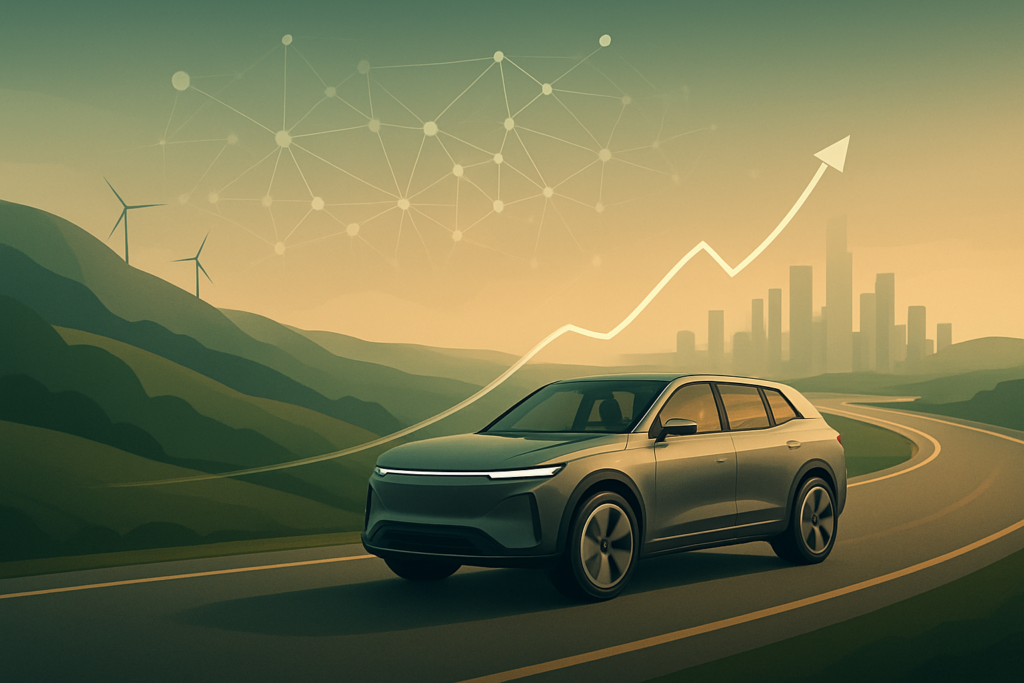
As the global automotive industry navigates the "second half" of the electric vehicle (EV) revolution—transitioning from electrification to intelligent automation—Li Auto (Nasdaq: LI) finds itself at a critical juncture. Once the undisputed darling of the Chinese "New Forces," the company entered 2026 coming off a humbling 2025 that saw its delivery momentum challenged by the "Huawei effect" and a brutal domestic price war.
Today, the narrative surrounding Li Auto has shifted. It is no longer just a manufacturer of range-extended family SUVs; it has rebranded itself as an AI powerhouse. With the full rollout of its end-to-end (E2E) autonomous driving large model and the integration of Vision-Language-Action (VLA) architecture, Li Auto is betting that "Silicon over Steel" will be the catalyst for its 2026 recovery.
Historical Background
Li Auto was founded in 2015 by Li Xiang, a serial entrepreneur who previously founded the successful automotive portal Autohome. Unlike its peers NIO and XPeng, which bet heavily on pure Battery Electric Vehicles (BEVs), Li Auto took a contrarian path by championing Extended-Range Electric Vehicles (EREVs).
The company’s first model, the Li ONE, launched in 2019, solved the "range anxiety" that plagued early Chinese EV adopters by using a small gasoline engine to charge the battery. This pragmatic approach allowed Li Auto to reach profitability faster than any of its rivals. By 2023, the company had established a dominant lead in the premium family SUV segment, culminating in a record-breaking 2024 where it delivered over 500,000 vehicles and became the first emerging Chinese brand to reach 1 million cumulative sales.
Business Model
Li Auto’s business model is built on three pillars: Product Definition, Vertical Integration, and Extended Range Dominance.
The company targets "premium family users," designing vehicles with features like "refrigerator-color TV-large sofa" configurations that have since become industry standards in China. Revenue is primarily derived from vehicle sales, supplemented by a growing software-as-a-service (SaaS) component through its AD Max autonomous driving subscriptions.
In 2025, the company diversified its model into two streams:
- The L-Series (EREV): The high-margin bread and butter, including the L6, L7, L8, and flagship L9.
- The i-Series (BEV): A high-risk, high-reward push into pure electric power, led by the futuristic (and polarizing) Li MEGA MPV and the newly launched i6 and i8 SUVs.
Stock Performance Overview
Since its IPO on the Nasdaq in July 2020 at $11.50 per share, Li Auto’s stock (Nasdaq: LI) has been a volatile performer, reflective of the broader "China ADR" sentiment and the intense competition in the NEV (New Energy Vehicle) sector.
- 1-Year Performance: The stock has struggled over the past 12 months, down approximately 14% as of early 2026, primarily due to a 2025 delivery miss and margin compression.
- 5-Year Performance: Despite recent headwinds, long-term investors from the 2020-2021 era have seen significant gains, with the stock outperforming peers like NIO and XPeng due to Li Auto’s superior path to profitability and cash flow management.
- 10-Year Performance: N/A (The company has been public for less than 6 years).
Financial Performance
The 2025 fiscal year was a "test of fire" for Li Auto’s balance sheet. After a stellar 2024 with 144.5 billion RMB in revenue and over 8 billion RMB in net income, 2025 saw a contraction.
Preliminary data for FY 2025 suggests total revenue of approximately 113.1 billion RMB, an 18.8% year-over-year decline. Gross margins, which once sat comfortably above 21%, dipped to the 15-17% range in late 2025 as the company was forced to offer aggressive discounts to counter Huawei’s AITO M9. However, Li Auto maintains one of the strongest cash positions in the industry, with over 90 billion RMB in reserves, providing a massive "war chest" for its 2,560 TOPS in-house silicon development.
Leadership and Management
Li Xiang remains the visionary force behind the company. Often compared to Elon Musk for his product-centric obsession and active social media presence, Li has successfully cultivated a "product manager" culture within the firm.
In 2025, the leadership team was reinforced with top-tier AI talent from global semiconductor firms to lead the "M-Project"—Li Auto’s in-house chip division. The governance reputation remains high among institutional investors who view Li Auto as the most "operationally disciplined" of the Chinese EV startups.
Products, Services, and Innovations
The core of the Li Auto 2026 thesis is the AI Driver Large Model. Moving away from traditional perception/planning modules, Li Auto has deployed a "One Model" end-to-end architecture.
- MindVLA: This system unifies a 2.2-billion parameter Vision-Language Model (VLM) that allows the car to "reason." It can interpret complex scenarios, such as a traffic officer's hand signals or the intent of a pedestrian standing near a puddle.
- M100 Silicon: The 2026 models are the first to feature the M100 in-house chip, capable of 2,560 TOPS. This allows for localized processing of the VLA model without relying on cloud latency.
- Livis Chassis: The new 800V active chassis system in the 2026 L9 flagship allows for a "magic carpet" ride quality that uses AI to predict road irregularities 500 meters ahead.
Competitive Landscape
The competitive environment in 2026 is dominated by the "War of the Large Models."
- AITO (Huawei): Currently Li Auto’s fiercest rival. Huawei’s ADS 4.0 system is considered the benchmark in China. The AITO M9 outsold the Li L9 for several months in 2025, forcing Li Auto into the current AI-first pivot.
- Tesla (Nasdaq: TSLA): With FSD (Full Self-Driving) now officially operational in China, Tesla remains a formidable threat, though Li Auto’s LiDAR-integrated systems are currently performing with fewer interventions in dense urban "village-in-city" scenarios.
- BYD (OTC: BYDDY): While BYD dominates the mass market, its premium brands (Yangwang and Fangchengbao) are beginning to nibble at Li Auto’s high-end market share.
Industry and Market Trends
The Chinese NEV market has entered a "survival of the fittest" phase. NEV penetration in China has crossed 50%, meaning growth is no longer about converting internal combustion engine (ICE) users, but about stealing market share from other EV players.
The primary trend in 2026 is the "de-coupling" of hardware and software value. While the car's body is becoming a commodity, the "digital soul"—the AI model—is where the premium margin now resides. Li Auto’s move to make its AD Max hardware standard across its updated L-series reflects this shift.
Risks and Challenges
- Hardware Saturation: There is a risk that the "family SUV" design language has reached its limit, as evidenced by the delivery slowdown in 2025.
- BEV Adoption: The Li MEGA’s slow start suggests that Li Auto’s brand power may not translate as easily to pure electric vehicles as it did to EREVs.
- The "Huawei Shadow": Huawei’s massive ecosystem and R&D budget (exceeding 100 billion RMB annually) pose an existential threat to independent manufacturers like Li Auto.
Opportunities and Catalysts
- 2026 Recovery Target: Management has set a 550,000-unit delivery target for 2026. Reaching this would signal a definitive V-shaped recovery.
- Overseas Expansion: Li Auto has historically focused solely on China. In 2026, the first "International Edition" models are expected to launch in the Middle East and Central Asia, opening a new growth lever.
- AI Monetization: If the MindVLA system proves superior, Li Auto could potentially license its software stack to other Tier-2 manufacturers.
Investor Sentiment and Analyst Coverage
Wall Street remains cautiously optimistic. While firms like Morgan Stanley have praised Li Auto’s "relentless execution," others remain wary of the 2025 margin dip.
Institutional ownership remains high, with major positions held by the likes of Baillie Gifford and BlackRock. Retail sentiment in China, often a precursor to stock movement, has improved following the successful Jan 2026 rollout of the "One Model" software update, which significantly improved urban navigation performance.
Regulatory, Policy, and Geopolitical Factors
Li Auto operates in a complex regulatory web. While the Chinese government continues to support the NEV transition through "Trade-in" subsidies, the company faces significant hurdles abroad.
The 2026 geopolitical climate remains tense, with EU and US tariffs effectively locking Li Auto out of those markets for the foreseeable future. This has forced the company to double down on the domestic "Smart City" initiatives, aligning its AI development with China’s national "Vehicle-Road-Cloud" integration standards.
Conclusion
Li Auto enters February 2026 as a company in the midst of a profound transformation. The "delivery momentum" that once seemed effortless is now something it must fight for with every software update and every new BEV launch.
The success of the new AI driver large model rollout is not just a feature—it is the company’s new foundation. If Li Auto can prove that its VLA architecture offers a safer, more human-like driving experience than Huawei or Tesla, it will likely reclaim its spot as the premium leader. However, the margin for error is razor-thin. For investors, the "watch items" for the remainder of 2026 are clear: quarterly gross margin stabilization and the reception of the new i-series SUVs in a saturated market.
This content is intended for informational purposes only and is not financial advice. Today's Date: February 9, 2026.