On February 23, 2026, Walmart Inc. (NYSE: WMT) solidified its position as a dominant titan of the modern economy, with its market capitalization officially crossing the historic $1 trillion threshold. This milestone comes during a transformative week for the retail giant, fueled by a landmark U.S. Supreme Court ruling regarding tariff refunds that has sent shockwaves through the consumer discretionary sector. As Walmart pivots from a traditional big-box retailer into a high-margin technology and data ecosystem, the convergence of favorable legal outcomes and aggressive automation has made it the central focus of global equity markets. Today’s surge in investor interest is not merely a reaction to retail sales but a validation of a decade-long metamorphosis.
Historical Background
Founded by Sam Walton in 1962 in Rogers, Arkansas, Walmart’s early narrative was defined by the "Everyday Low Price" (EDLP) philosophy and a revolutionary approach to supply chain logistics. For decades, the company’s growth was driven by aggressive physical expansion into rural and suburban America. However, the 21st century demanded a radical shift. The 2016 acquisition of Jet.com for $3.3 billion marked the beginning of the "McMillon Era," during which Walmart aggressively moved into e-commerce to challenge digital incumbents. Key milestones, such as the 2018 majority stake in India’s Flipkart and the 2024 acquisition of smart-TV maker VIZIO, transitioned the company from a store-based model to an omni-channel platform integrating retail, media, and logistics services.
Business Model
Walmart’s business model in 2026 is a sophisticated multi-revenue stream "flywheel." While the core remains high-volume retail across Walmart U.S., Walmart International, and Sam’s Club, the profit engines have shifted.
- Retail & Grocery: Still the foundational volume driver, with Walmart controlling roughly 25% of the U.S. grocery market.
- Walmart Connect: A high-margin retail media business that leverages first-party shopper data to sell targeted advertising.
- Walmart Luminate: A data-as-a-service (DaaS) product where suppliers pay for granular consumer insights.
- Walmart+: A membership-based recurring revenue stream providing delivery, fuel discounts, and streaming via Paramount+.
- Fulfillment Services: Leveraging its physical footprint to provide "Last-Mile-as-a-Service" for third-party marketplace sellers.
Stock Performance Overview
The last decade has seen WMT evolve from a defensive value play into a high-performing compounder.
- 10-Year Horizon: WMT has significantly outperformed the S&P 500, particularly during the inflationary period of 2022-2024 where its value proposition attracted "trade-down" shoppers from higher-income brackets.
- The 2024 Catalyst: The 3-for-1 stock split in February 2024 served as a major liquidity event, broadening retail ownership and preceding a 72% rally that year.
- Recent Performance: Over the past year leading into February 2026, the stock has climbed 45%, buoyed by record-breaking FY2026 earnings and the recent inclusion in the NASDAQ 100, which forced massive institutional buying.
Financial Performance
In its most recent fiscal year (ending January 31, 2026), Walmart reported a staggering $713.2 billion in total revenue, surpassing the $700 billion mark for the first time.
- Margins: Operating margins expanded to 4.8%, up from historic lows of 4.1% in 2023, driven by the growth of advertising and data services.
- E-commerce: Digital sales now account for 23% of total revenue, with a clear path toward profitability as fulfillment automation scales.
- Cash Flow: Free cash flow remains robust at $18.5 billion, allowing for consistent dividend increases (now in its 53rd consecutive year) and aggressive share buybacks.
- The Refund Windfall: Analyst projections suggest the recent tariff ruling could inject an additional $3.5 billion to $5 billion in one-time cash refunds over the next 18 months.
Leadership and Management
A new chapter began on February 1, 2026, with John Furner taking over as President and CEO following Doug McMillon’s retirement. Furner, who previously led Walmart U.S., is a seasoned veteran known for his "associate-first" culture and digital fluency. Under his leadership, the management team has doubled down on "Agentic Commerce"—the use of autonomous AI agents to manage household inventories. The board remains highly regarded for its disciplined capital allocation and its success in navigating the complex transition from physical to digital dominance.
Products, Services, and Innovations
Innovation at Walmart is currently focused on the "Automated Store" and "Generative AI."
- Supply Chain: By early 2026, 60% of U.S. stores are serviced by automated distribution centers, reducing out-of-stocks and labor costs.
- Sparky (AI Assistant): Walmart’s generative AI shopping assistant now handles complex queries like "Plan a gluten-free birthday party for 10 kids under $100," adding items directly to the cart.
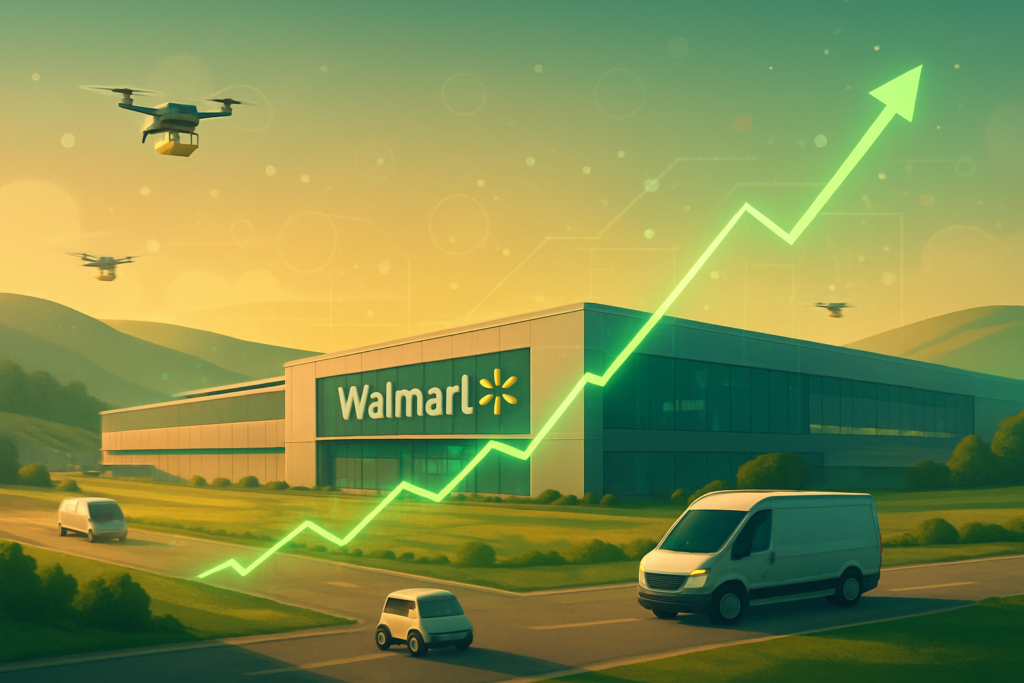
- Drone Delivery: Following regulatory easing in 2025, Walmart now offers 30-minute drone delivery to over 15 million households in 10 states.
- Health & Wellness: The expansion of Walmart Health clinics into primary care and clinical trials has turned pharmacy visits into a comprehensive healthcare service.
Competitive Landscape
While Amazon (NASDAQ: AMZN) recently eclipsed Walmart in total annual revenue, the competitive landscape has bifurcated.
- vs. Amazon: Walmart maintains a superior "physical moat" with 90% of the U.S. population living within 10 miles of a store, allowing for more efficient grocery fulfillment than Amazon’s Whole Foods or Fresh units.
- vs. Discount Rivals: In the face of pressure from Temu and Shein in the apparel and "general merchandise" segments, Walmart has pivoted toward quality and reliability, successfully siphoning market share from domestic dollar stores.
- vs. Costco: Sam’s Club has aggressively closed the gap with Costco (NASDAQ: COST) by implementing digital-only checkout experiences, appealing to a younger, tech-savvy demographic.
Industry and Market Trends
The retail sector in 2026 is defined by "The Great Bifurcation." High-income consumers are increasingly seeking convenience and time-savings, while middle-and-lower-income tiers remain hyper-focused on value due to the lingering effects of the 2022-2024 inflation cycle. Walmart is uniquely positioned to capture both, using its premium Walmart+ service for the former and its EDLP pricing for the latter. Furthermore, the industry is seeing a massive shift toward "Retail Media," where the physical store becomes an advertising canvas, a trend Walmart is currently leading.
Risks and Challenges
Despite the $1 trillion valuation, several headwinds remain:
- Labor Costs: As the largest private employer in the U.S., Walmart remains sensitive to wage inflation and potential unionization efforts in key hubs.
- International Volatility: Geopolitical tensions in Southeast Asia and the Middle East continue to disrupt global sourcing, requiring costly supply chain diversifications.
- Execution Risk: The heavy reliance on AI and automation carries the risk of technical failures or consumer backlash regarding data privacy and "algorithmic pricing."
Opportunities and Catalysts
- The Tariff Refund: The Supreme Court’s February 20, 2026 ruling against the IEEPA "Emergency" tariffs is the most immediate catalyst. This could result in a massive cash infusion, potentially earmarked for a special dividend or further M&A.
- OnePay Expansion: Walmart’s proprietary financial services app, OnePay, is positioned to become a major player in the "Buy Now, Pay Later" (BNPL) and digital banking space, competing directly with fintech incumbents.
- B2B Services: Selling its proprietary logistics and data software to other small-to-mid-sized retailers represents an untapped multibillion-dollar high-margin opportunity.
Investor Sentiment and Analyst Coverage
Sentiment on the Street is overwhelmingly bullish. Following the tariff ruling, major investment banks have revised their price targets upward, with several calling WMT a "Top Pick for 2026." Institutional ownership remains high, with significant increases from ESG-focused funds who have praised Walmart’s 2025 carbon neutrality milestones. Retail sentiment is also strong, as the VIZIO integration has made Walmart a household "tech" brand rather than just a grocer.
Regulatory, Policy, and Geopolitical Factors
The regulatory environment is the primary driver of today's market activity.
- The IEEPA Ruling: On February 20, 2026, the Supreme Court ruled 6-3 that broad global tariffs imposed under the International Emergency Economic Powers Act were unconstitutional. Walmart, as a top importer, is lead claimant for refunds on billions in duties paid during the 2025 "Trade Emergency" period.
- Section 301 Status: While the court upheld the older China-specific Section 301 tariffs in late 2025, the IEEPA ruling provides a more significant direct cash benefit for 2026 balance sheets.
- Antitrust: Walmart’s growing dominance in digital advertising is drawing scrutiny from the FTC, though analysts believe the presence of Amazon and Google provides a sufficient competitive defense.
Conclusion
Walmart’s journey to a $1 trillion market cap on February 23, 2026, is a testament to the power of digital transformation in a legacy industry. By successfully pivoting from a vendor of goods to a provider of services—advertising, data, health, and automated logistics—the company has decoupled its growth from the thin margins of traditional retail. While the immediate boost from the Supreme Court’s tariff refund ruling provides a lucrative catalyst, the long-term thesis for WMT rests on its ability to integrate its physical footprint with its digital "Flywheel." Investors should monitor the integration of the OnePay financial ecosystem and the ongoing scaling of automated fulfillment as the next markers of performance. Walmart is no longer just a store; it is a vital piece of 21st-century infrastructure.
This content is intended for informational purposes only and is not financial advice.