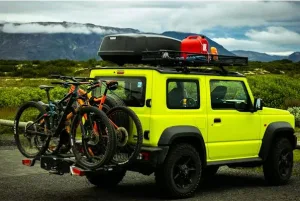
The Jimny has been considered one of the most versatile compact off-road vehicles. The tough design and lightweight construction, along with this vehicle’s freedom of movement, make people interested in exploring places far from civilization.
Nevertheless, while the off-roading experience can be an extremely interesting adventure, a small storage area is always a problem. If you decide to camp in the wild or embark on a serious overlanding journey, it is important to have enough storage space on the vehicle, which you can gain by installing the right roof rack.
Therefore, finding the right roof rack will require some time and effort, as it is essential to consider not only its functionality but also it’s durability and weight capacity. The perfect roof rack should reflect the vehicle’s off-road nature.
Below are some of the things to look out for when choosing a roof rack that matches the Jimny off-road spirit.
1. Prioritize Compatibility with the Vehicle
Another important aspect when choosing a Suzuki Jimny roof rack is ensuring that it is tailored to the Jimny’s roof size and mounting points. The reason is that the roofs of off-road compact cars have unique shapes; therefore, the rack should be compatible with the roof to ensure safety and minimize unnecessary movement while driving on off-road trails.
Another benefit is that such a roof rack will distribute weight evenly across the roof and prevent damage to the mounting points when driving over uneven surfaces. On the contrary, an inappropriate roof rack could cause vibrations or even make your car louder than usual.
2. Consider Weight Capacity Carefully
While increasing storage capacity is the main concern, placing too much weight on the roof may affect performance and handling. That is why it is necessary to consider both the roof rack’s load capacity and the vehicle’s capacity before purchasing.
The dynamic load capacity is the load the rack can safely carry during vehicle operation. In contrast, the static load capacity is the load the rack can support when the car is stationary. This information will be especially useful for those who plan to use a rooftop tent or other camping equipment.
Additionally, minimizing roof load helps maintain Jimny’s balance, since the car’s lightness makes it perfect for off-road driving.

3. Choose Durable Materials for Harsh Conditions
Off-road activities will cause the equipment to encounter muddy conditions, water, dirt, rocks, and vibrations all at once. Therefore, the type of material used to construct the roof rack will determine its durability and reliability.
Aluminum roof racks have become very popular because they offer a perfect combination of strength and lightness. As aluminum does not corrode easily, it will work well in moist, cold conditions without adding additional weight to the vehicle.
Steel roof racks are known to be extremely strong and durable. Though they may be heavier, steel roof racks are generally favored by people carrying heavy equipment or traversing through tough terrain.
4. Think About Your Adventure Style
Everyone who drives a Jimny is not going to use it in the same way. Thus, the kind of outdoor activities that you engage in must play a major role in determining the type of roof rack you will need.
For example, if your outdoor activity of choice involves camping, you might find it useful to have a platform roof rack that can accommodate boxes and boards, camping chairs, and even lightweight tents. On the other hand, if your outdoor activities involve bikes, kayaks, or skis, it would be best to go for a modular rack.
Thus, by choosing the right roof rack for your outdoor activities, you ensure you do not waste money on unnecessary features.
5. Look for Accessory Compatibility
One of the main strengths of contemporary roof racks is their versatility, which allows them to accommodate a range of accessories. Not simply used to carry loads of goods, many roof racks are designed to serve as platforms for organizing various items needed for adventures.
This way, mounting accessories that work well with your specific roof rack may include awnings, shovel mounts, traction boards, fuel and water tanks, lighting mounts, and cargo nets. As you expand your horizons in outdoor adventures, it becomes easier to customize your system without buying a new roof rack.
6. Balance Aerodynamics and Practicality
Despite the advantages associated with roof racks, there is no way to avoid affecting airflow around the car. Selecting an optimal solution that balances practicality and aerodynamics is advisable.
Lower roof racks typically generate less wind resistance and less noise when traveling down the highway. It results in a quieter ride and has minimal effect on the car’s fuel efficiency.
Also, less-profiled solutions are less likely to snag tree branches when going off-road. It is also beneficial, along with the Jimny’s small size, making it possible to navigate forest paths without issue.
7. Pay Attention to Installation and Maintenance
The ease of installation may be a significant factor, particularly for people who sometimes remove their roof racks between journeys.
Many modern racks have an easy-to-install design that can be mounted using only common tools. This makes installation fast and improves reliability and performance when driving on tough roads.
Maintenance is also another significant factor to consider. Inspecting the mounting bolts, cleaning the rack of dirt, and checking for any signs of rust help prolong its life.

8. Focus on Safety Above Everything Else
Regardless of how robust a roof rack may look, safe loading is still critical. Even distribution of the load will help avoid problems caused by uneven weight distribution on the vehicle or excessive strain on some particular mounting points.
Also, ensuring that all the equipment is secured with good straps or tie-down systems reduces any chance of sliding during a bumpy ride. Unsecured items are dangerous not only to your car but also to other people on the road.
Conclusion
Selecting a roof rack that really fits the off-road nature of the Jimny is not just about getting extra space, but about finding a solution compatible with the car’s small size, off-road capability, and adventurous nature.
The materials used, proper weight distribution, and compatibility with accessories will contribute to a more enjoyable experience on the road. Similarly, you need to ensure that the roof rack provides additional benefits without compromising the ease of handling your car.