The print versus digital debate is usually framed as a question of which channel is obsolete. That framing has never matched how businesses actually buy advertising. The two formats are bought for different reasons, behave differently in front of an audience, and fail in different ways. Treating them as interchangeable is how marketing budgets get spent badly in both directions.
Digital Wins on Targeting and Iteration
The strength of digital advertising is control. An ad can be aimed at a defined audience, changed the same afternoon, paused when it underperforms, and tested against a variant until one wins. Nothing in print offers that speed.
Digital also closes the loop. A click leads somewhere measurable, and the path from impression to action can be traced. For businesses that need to prove what their advertising did, that visibility is the main argument for the channel.
The weakness is crowding. A digital ad competes with everything else on the screen, including the content the user came for. Attention is short, skippable, and increasingly filtered out by habit.
Commercial Printing Wins on Attention and Permanence
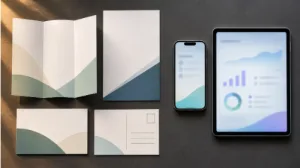
A printed piece occupies physical space. A brochure sits on a desk. A postcard stays on a counter until someone decides what to do with it. A presentation folder goes into a meeting and comes out again. None of this is skippable the way a banner ad is.
That permanence changes the kind of message print suits. It is a poor fit for a promotion ending Friday. It is a strong fit for anything a prospect needs to hold, compare, or pass to someone else, which is why print still dominates trade show display printing, in-store retail and anything involving a sales conversation.
Print also carries a signal digital struggles to replicate. Producing something physical implies commitment, and audiences read it that way without consciously thinking about it. Businesses working with a commercial printer such as fivedprint.com are usually buying that signal as much as the paper.
Where Each Format Breaks Down
Digital breaks down when the audience is narrow and offline. Reaching the decision makers at a few dozen local companies through a digital platform means paying to reach everyone who looks superficially similar to them. A physical piece sent directly, or handed over in person, reaches exactly who it is meant to.
Print breaks down when speed and flexibility matter. A mistake in a printed run is permanent. An offer that changes weekly does not belong on paper. If the message is still being tested, test it digitally first.
Flyers, Brochures and Banners in a Digital Plan
In practice the two formats work best in sequence rather than in competition. Digital is used to find out which message lands, and print is used to commit to the message that won. A headline that performed across digital campaigns is a far safer thing to put on a thousand flyers than a headline nobody has tested.
The reverse pairing also works. A brochure or banner that puts a brand in front of someone physically makes the digital follow up far less cold, because the name is already familiar.
Three Questions That Settle a Specific Campaign
- Does the audience need to be found, or is it already known? Unknown audiences favour digital targeting. Known lists and foot traffic favour print.
- Does the message need to change soon? If yes, keep it digital until it stabilizes.
- Does the piece need to survive the moment it is seen? If yes, print is the only format that does that by default.
The Real Risk Is Defaulting
The most common mistake is not choosing the wrong channel. It is defaulting to one because it is familiar, and then judging the other by a campaign that was never designed properly in the first place. A badly designed flyer and a badly targeted digital ad both fail, and neither failure says anything useful about the format.
Businesses that get value from both treat them as different tools in the same project, with different jobs, different timelines and different definitions of success.