Chinese e-commerce and AI giant Alibaba (BABA) recently announced that it would combine all of its AI ventures into a single unit. While the new division could allow the firm's AI businesses to coordinate more effectively and cross-sell products to each other's customers more prolifically, the change is not what makes BABA stock attractive for some investors at this point.
Rather, the strong performance of the firm's cloud unit in the third quarter, along with the positive data posted by the Chinese economy so far this year and the fairly low valuation of BABA stock, makes the shares worth buying for patient investors with a somewhat high risk tolerance.
About Alibaba
In addition to e-commerce and AI, Alibaba has entertainment, logistics, and digital media ventures.
In Q3, its revenue rose 2% versus Q3 of 2024 to 247.65 billion Chinese yuan, or $34.6 billion. However, its net income excluding profits on investments sank 18% year-over-year (YoY).
The shares have a price-earnings ratio of 20.25 times and a market capitalization of $326.4 billion.
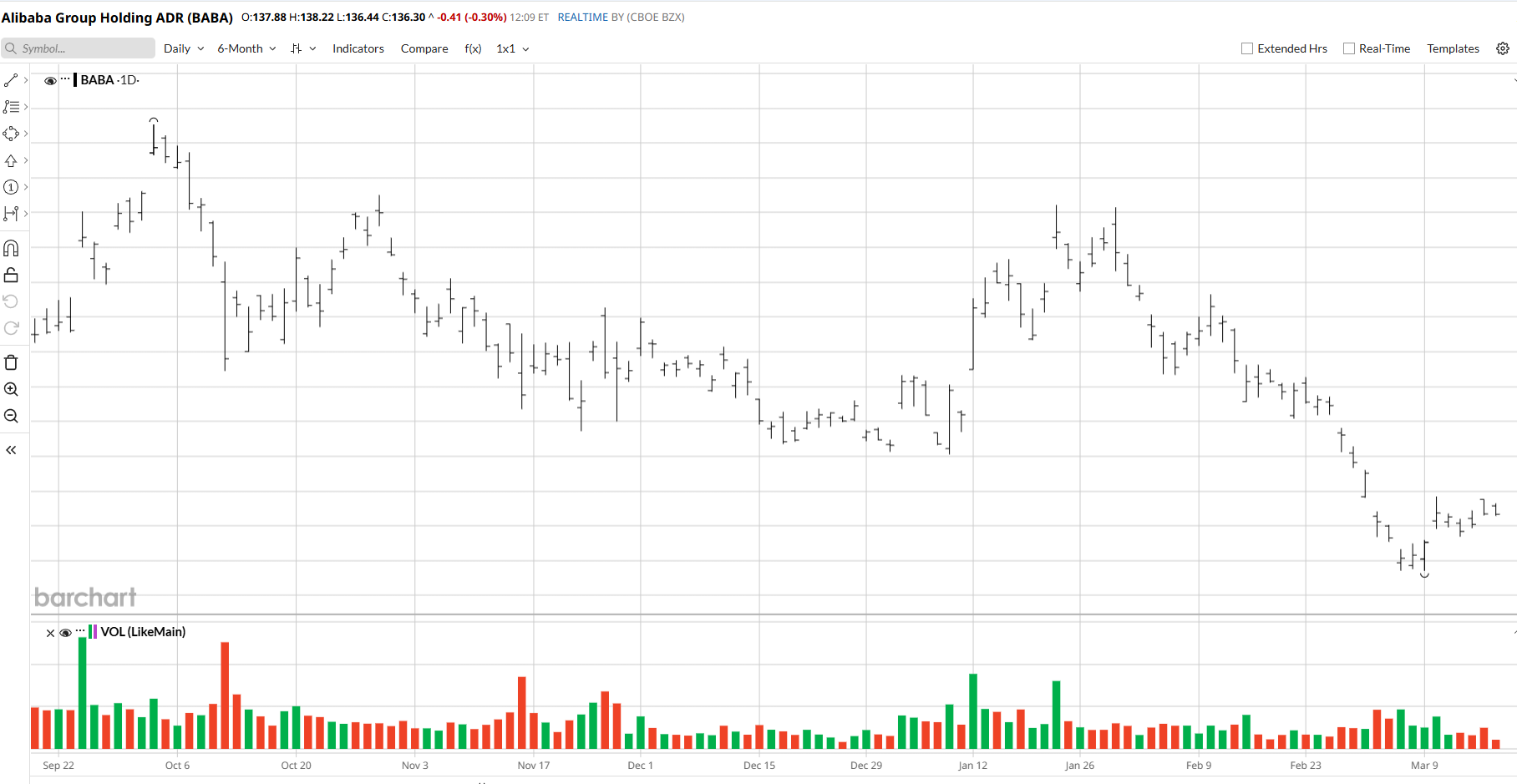
Cloud's Encouraging Performance in Q3 Suggests the AI Businesses Are Thriving
In Q3, the top line of the company's cloud computing unit jumped 26% versus the same period a year earlier. That marked a significant acceleration versus Q2, when the division's sales increased 18% YoY. CEO Eddie Wu attributed the division's strong performance in Q3 to “robust AI demand” and added that “AI-related product revenue is now a significant portion of revenue from external customers.”
The cloud unit's strong showing in Q3, in tandem with Wu's statements, leads me to believe that Alibaba's AI offerings, in which the firm has invested meaningful amounts of funds, improved significantly during Q3. Further, the company can relatively easily and effectively market its AI offerings to the huge number of businesses that sell products on its websites, even as many more of these firms are likely looking to start utilizing AI. Indeed, a high percentage of the vendors on BABA's websites may be interested in using “the dedicated agentic AI service for businesses” that it launched today.
Also importantly, Barron's reported recently that “while China’s best AI generally remains several months behind the leading U.S. models, Chinese developers have gained a substantial foothold in the market by offering open-source models that users can modify.” BABA, which markets many open-source AI systems, appears to be capitalizing on the trend cited by Barron's.
China's Economy Appears to Be Making a Comeback
China's industrial output surged 6.3% in the first two months of the year, and the country's retail sales advanced 2.8% YoY. Further, investment in its infrastructure jumped 11.4% YOY. If China's economy continues to perform well, the growth of BABA's e-commerce businesses should meaningfully accelerate going forward.
Valuation and the Bottom Line on BABA Stock
Alibaba's price-earnings ratio of 20.25 is rather low, particularly if the growth of its AI and e-commerce businesses meaningfully accelerates, enabling its bottom line to increase significantly in Q4 and subsequent quarters.
But the war in the Middle East does create meaningful risks for BABA stock, given China's dependence on oil from the region.
Consequently, BABA stock appears to be well-suited only for patient investors with a fairly high risk tolerance at this point.
On the date of publication, Larry Ramer did not have (either directly or indirectly) positions in any of the securities mentioned in this article. All information and data in this article is solely for informational purposes. For more information please view the Barchart Disclosure Policy here.
More news from Barchart
- This Ukraine War Drone Company Just Skyrocketed After Its IPO. Should You Buy Swarmer (SWMR) Stock Here?
- 2 Homeland Security Stocks Well-Priced for Long Call Strategies as the Iran War Drags On
- Mark Cuban Warns That Some People Will Use AI to ‘Avoid Learning Anything,’ But Smart Investors Can Use It to ‘Help Them Learn Everything’
- Up 1,520% in a Year, This Energy Stock Just Hit a New 52-Week High. Should You Buy It Now?