Designed for AI vision and security deployments that must perform equally well in daylight and after dark, this HDR camera pairs a Sony STARVIS 2 IMX662 Camera sensor with on-chip dynamic range combination and GigE Vision networking, enabling consistent low-light image capture over Power over Ethernet infrastructure without added illumination or specialized cabling.
FORT WORTH, TX / ACCESS Newswire / August 12, 2026 / Vadzo Imaging, a provider of embedded vision solutions, today introduced the Innova-662CRE, a 2MP GigE Camera built around the Sony IMX662 STARVIS 2 sensor for low light AI vision, surveillance, and machine vision deployments that require on-chip HDR and PoE network connectivity.
Why AI Vision Systems Need a 2MP GigE Camera Built for Low Light Conditions
Machine vision and AI inference pipelines depend on consistent image quality across a full range of ambient lighting conditions, yet most networked camera deployments still rely on sensors optimized mainly for daylight performance. In parking structures, warehouse loading docks, perimeter fencing, and continuously operating retail environments, illumination can swing from several thousand lux at midday to a fraction of a lux after dusk. A camera module without extended low-light sensitivity produces noisy, motion-blurred, or underexposed frames precisely when an AI vision model needs its cleanest input for accurate detection and classification.
Extending a Low Light GigE Camera into mixed light scenes exposes two engineering problems at once. The first is photon starvation: as ambient light drops, a sensor with a small pixel or without Back-Side Illuminated architecture struggles to collect enough signals above its read noise floor. The second is dynamic range collapse: headlights, floodlights, and reflective surfaces at night create localized highlights that clip alongside dark shadow regions in the same frame, a problem that basic auto exposure cannot solve because a single exposure setting cannot serve both extremes at once.
Engineering Explanation: Solving Low Light and Dynamic Range Together
Sony's STARVIS sensor lineup addressed the low light photon collection problem through Back-Side Illuminated pixel architecture, and STARVIS 2 extends that foundation with a redesigned pixel structure that improves quantum efficiency further into the near infrared spectrum while reducing dark current noise at longer exposure times. The result is a Sony STARVIS 2 Camera platform that captures usable detail at illumination levels where sensors lacking Back-Side Illuminated construction return mostly noise.
For the dynamic range half of the problem, the same sensor generation adds on-chip exposure combination, referred to in datasheets as DOL HDR, which reads two or more exposure values per pixel within a single frame period and merges them before the data leaves the sensor package. This produces a Low Light HDR Sensor response that neither clips a headlight nor loses shadow detail beside it, without the frame-to-frame ghosting that affects software-based multi-frame HDR.
Pairing an IMX662 HDR GigE Camera architecture with a GigE Vision interface completes the system-level design. GigE Vision runs over standard Ethernet infrastructure, supports Power over Ethernet for combined data and power delivery on a single cable, and scales to cable runs up to 100 meters without a repeater, which matters for perimeter security, warehouse ceiling mounts, and traffic infrastructure where routing USB or MIPI cabling back to a host computer is impractical.
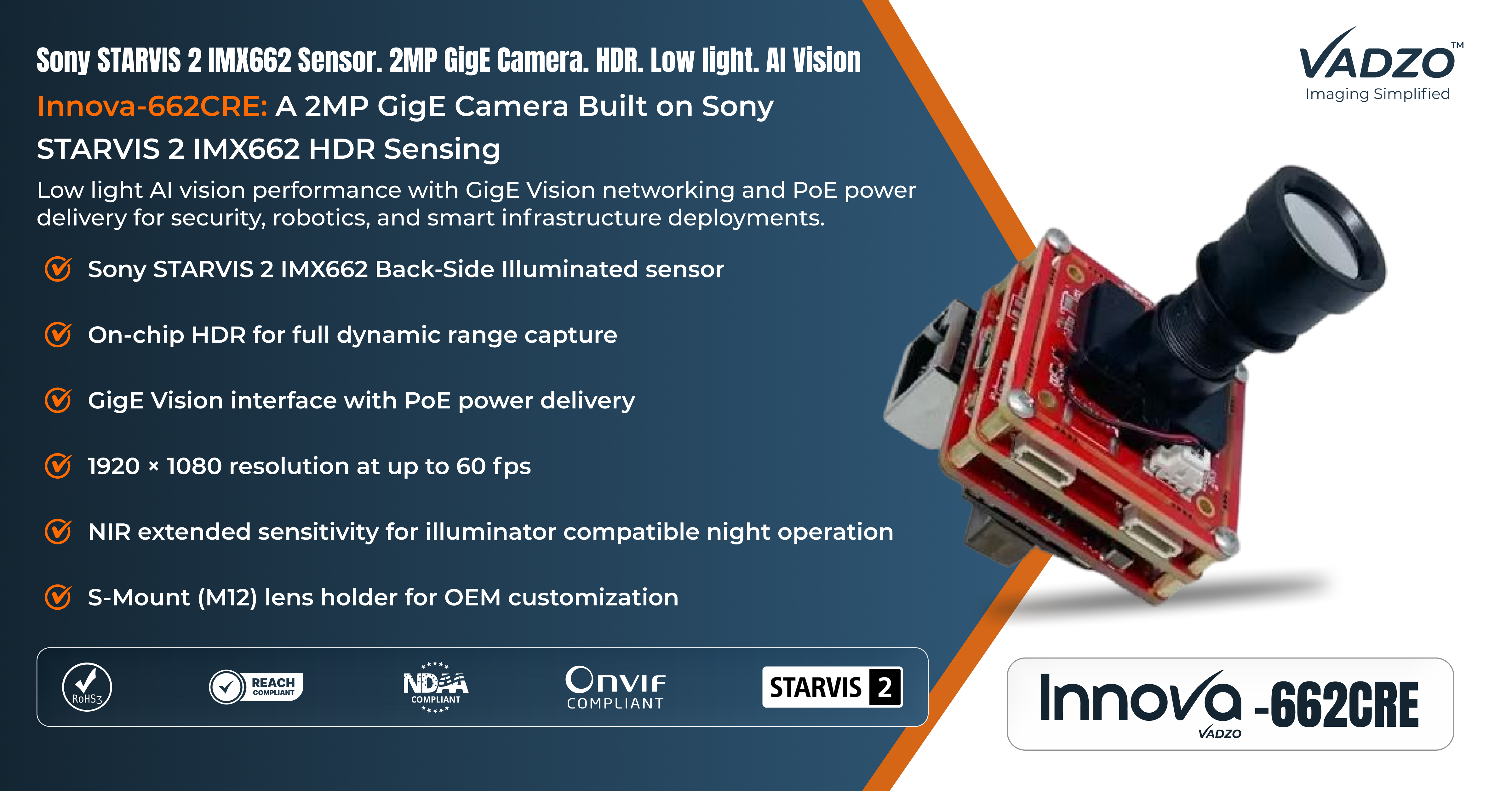
Product Overview
The Innova-662CRE pairs the Sony IMX662 Camera sensor with a fully integrated GigE Vision interface, PoE power delivery, and an S-Mount (M12) lens holder with Electromechanical IR Filter in a compact board-level design suited to both direct integration and enclosed camera deployment. As a 2MP GigE Camera, it outputs 1920 × 1080 resolution at up to 60 frames per second with on-chip HDR active, giving system integrators a single camera platform that covers daylight, twilight, and near-total-darkness scenes without switching sensors or adding external illumination for most application distances.
At the core of the module sits the IMX662 Sensor, a 1/2.8-inch optical format device with 2.9-micron pixels and Back-Side Illuminated construction that Sony markets under the STARVIS 2 label for extended low light and near infrared sensitivity. Because the sensor was engineered as a 2MP Low Light Sensor from the ground up, the Innova-662CRE reaches usable exposure at illumination levels where competing modules typically require gain increases that introduce visible noise into an AI vision pipeline. This lets it function as an Ultra Low Light gigabit ethernet Camera suited to unlit outdoor scenes as well as a general-purpose daytime camera on the same hardware.
Key Capabilities
Back-Side Illuminated STARVIS 2 Sensor for Ultra Low Light Sensitivity: The Innova-662CRE inherits Sony's Back-Side Illuminated STARVIS 2 pixel architecture, which routes a larger share of incoming photons to the photodiode compared with designs lacking Back-Side Illuminated construction at a similar pixel size. In practical deployment terms, that translates into a STARVIS 2 HDR Camera platform that holds usable signal-to-noise ratio well past the point where conventional sensors fall into visible grain. Integrators building perimeter security, unlit parking areas, or dusk-to-dawn monitoring get color image capture without relying on constant supplemental lighting.
On-Board HDR for Full Dynamic Range Capture: Because exposure combination happens inside the sensor rather than in a downstream image signal processor, the Innova-662CRE behaves as a genuine HDR Low Light Camera rather than a standard sensor with a software tone curve layered on top. Highlights from headlights, floodlights, or reflective metal surfaces stay controlled while shadow detail in the same frame remains visible, which is the behavior an HDR Gigabit Ethernet Camera needs to support downstream analytics reliably. The same sensor generation also ships in the 2MP HDR GigE Camera configuration used across Vadzo's high dynamic range portfolio, giving OEM customers a consistent imaging pipeline to standardize around.
ONVIF Profile S, T, M, and G Compliance for VMS Interoperability: A GigE camera that speaks only its own proprietary SDK creates integration work every VMS vendor has to redo from scratch. The Innova-662CRE ships with full ONVIF conformance across Profile S for standard video streaming, Profile T for advanced streaming with H.264/H.265 and metadata support, Profile M for analytics and event metadata, and Profile G for edge recording and playback. As an ONVIF GigE Camera, it plugs into existing VMS infrastructure using the same discovery, configuration, and streaming interface integrators already rely on for the rest of their camera fleet. The platform has been validated with Milestone VMS, giving system integrators a confirmed interoperability path rather than a conformance claim that still needs field verification. For OEMs building an ONVIF Low Light Camera deployment across mixed-vendor sites, that multi-profile support means one camera line covers live viewing, analytics integration, and edge recording workflows without vendor-specific middleware.
GigE Vision and PoE Networking for Simplified Long Range Deployment: As an IMX662 Gigabit Ethernet Camera, the Innova-662CRE communicates over standard Ethernet using the GigE Vision protocol, which most machine vision software already supports natively through GenICam. Power over Ethernet lets a single Cat5e or Cat6 cable carry both data and power to the camera, removing the separate power supply that a PoE Low Light Camera deployment would otherwise require. For engineers standardizing on a GigE Vision Low Light Camera platform across multiple sites, that single cable design meaningfully reduces installation labor and points of failure in the field.
AI Vision Ready Output for Edge and Server Side Inference: Consistent exposure and color reproduction across lighting conditions make the Innova-662CRE function as a dependable AI Vision GigE Camera for detection, classification, and tracking workloads running on edge compute or centralized servers. Because frame quality does not degrade sharply after dark the way it does with daylight-tuned sensors, a Smart Low Light Camera configuration like this one keeps inference accuracy stable through a full day and night cycle rather than only during business hours.
NIR Extended Sensitivity for Illuminator Compatible Night Operation: STARVIS 2 sensor technology extends quantum efficiency further into the near infrared band than earlier generations, which allows the Innova-662CRE to pair effectively with 850 nm or 940 nm NIR illuminators for fully covert night operation. This matters for facilities that cannot use visible light illumination without disturbing nearby residents or covert surveillance requirements, since the camera continues to deliver a clean, usable image under illumination from NIR sources alone.
Compact S-Mount Design for OEM Integration and Volume Production: The board-level module uses a standard S-Mount (M12) lens holder with Electromechanical IR Filter, giving OEM customers flexibility to select wide, narrow, or NIR-tuned optics without redesigning the camera electronics. Vadzo Imaging supports full customization on this platform as an OEM Low Light GigE Module, including connector changes, cable length adjustment, and enclosure design for volume production programs that need a networked low light camera without building sensor integration and driver support from scratch.
"Engineers building AI vision and surveillance systems keep asking us for one camera that behaves the same at noon and at midnight without a second sensor or a software patch. The IMX662's Back-Side Illuminated STARVIS 2 architecture combined with on-chip HDR gives the Innova-662CRE genuine low-light performance and full dynamic range in the same frame, and GigE Vision with PoE means integrators can place it anywhere on the network without a separate power run. We built this camera to remove the tradeoffs, not manage them." - Alwin Vincent, Product Manager at Vadzo Imaging.
Application-Specific Sections
Security and Surveillance: Perimeter fencing, parking structures, and building entrances need continuous coverage from daylight through complete darkness without a maintenance team swapping camera units twice a day. As a Night Vision GigE Camera with on-chip HDR, the Innova-662CRE handles glare from headlights and floodlights at the property line while an AI Surveillance GigE Camera configuration of the same hardware feeds detection and analytics software running on site or in the cloud. For sites standardizing on a single platform, the Low Light Security GigE Camera designation covers both recording and analytics duty from one camera line.
AI Vision and Smart City Analytics: Municipal deployments for crowd counting, parking occupancy, and public safety monitoring depend on consistent image quality around the clock, which is exactly where a Low Light AI Vision Camera earns its place in a smart city stack. The Innova-662CRE's GigE Vision interface integrates directly with existing municipal network infrastructure, while PoE simplifies pole and ceiling mount installations common in these deployments.
Robotics and Warehouse Automation: Autonomous mobile robots and fixed robotic inspection stations operating in warehouse aisles encounter both bright dock doors and dim storage rows within a single facility. A Low Light Robotics GigE Camera configuration keeps navigation and inspection camera products seeing clearly across that lighting range without tuning each zone separately, while the networked GigE Vision interface simplifies wiring across a fleet management or fixed infrastructure deployment.
Traffic Monitoring and License Plate Recognition: License plate recognition at intersections and tunnel entrances must handle headlight glare, shadowed underpasses, and full darkness within the same camera position. Operating as a 1080p Low Light Gigabit Ethernet Camera, the Innova-662CRE's on-chip HDR keeps plate characters legible against bright headlights, and standard GigE Vision output integrates directly with existing traffic management video infrastructure.
Industrial and Machine Vision Inspection: Production floors with mixed ambient lighting from skylights, task lighting, and shift changes create inconsistent conditions for automated inspection. A Low Light Machine Vision Camera built on this sensor platform maintains stable exposure and color accuracy across a shift without requiring a dedicated lighting enclosure at every station, and GigE Vision's long cable reach simplifies routing on large conveyor lines where USB length limits would otherwise force additional network hardware.
Frequently Asked Questions
Q: Does the Innova-662CRE support ONVIF?
A: Yes, the Innova-662CRE is ONVIF conformant across Profile S, Profile T, Profile M, and Profile G. Profile S covers standard video streaming and PTZ control, Profile T adds advanced streaming with H.264/H.265 encoding and metadata, Profile M supports analytics and event-based metadata, and Profile G handles edge storage and recording playback. This multi-profile coverage means the camera integrates with VMS platforms using standard ONVIF discovery and configuration rather than a proprietary SDK.
Q: Which VMS platforms is the Innova-662CRE validated with?
A: The Innova-662CRE has been validated with Milestone VMS. This confirms real-world interoperability for streaming, configuration, and ONVIF-based control within a Milestone deployment, rather than relying on conformance claims alone.
Q: What is the difference between ONVIF Profile S and Profile T?
A: Profile S is the baseline ONVIF profile for live video streaming, PTZ, and audio, while Profile T extends this with support for H.264/H.265 compression, video metadata streaming, and more granular imaging controls. The Innova-662CRE supports both, so integrators can choose the profile level that matches their VMS or NVR's ONVIF client implementation.
Q: Does ONVIF Profile M mean the Innova-662CRE supports on-camera analytics?
A: Profile M covers the metadata and event interface ONVIF defines for analytics, not on-camera analytics processing itself. It allows the Innova-662CRE to expose structured metadata, such as motion or object events, to a VMS or analytics engine over the standard ONVIF interface rather than a custom protocol.
Q: Can the Innova-662CRE be used for edge recording without a central VMS server?
A: Yes, Profile G support enables edge storage and recording playback directly through ONVIF, allowing the camera to work in edge-recording configurations. This is useful for deployments where continuous connectivity to a central VMS server is not guaranteed
Q: How far can a PoE GigE camera be installed from the network switch?
A: A GigE Vision camera that supports Power over Ethernet can typically run up to 100 meters over a single Cat5e or Cat6 cable without a repeater, carrying both data and power on the same run. This is a meaningful advantage over USB- or MIPI-connected camera products, which are limited to a few meters or centimeters respectively. Vadzo Imaging designs its PoE low light camera products to meet the IEEE 802.3af PoE standard and full GigE Vision compliance out of the box, so system integrators can extend a single network camera far beyond a control cabinet without custom cabling, extra power supplies, or nonstandard connectors. For longer runs, standard PoE extenders and managed switches let the same camera reach several hundred meters while remaining within the GigE Vision protocol.
Q: Why do AI vision systems perform poorly at night, and how does a low-light AI vision camera help?
A: Most machine learning models used for detection and classification are trained mainly on well-lit, daytime imagery. When frame quality degrades under low illumination, noise, motion blur, and underexposure all interfere with the input the model actually sees, which lowers detection confidence even though the algorithm itself has not changed. A low light AI vision camera addresses the problem at the image capture stage rather than asking software to compensate after the fact. By combining a high-sensitivity sensor with on-chip high dynamic range and consistent color reproduction, Vadzo Imaging's camera products deliver a cleaner, more consistent frame to the inference pipeline around the clock, which keeps detection accuracy stable from bright midday sun through near-total darkness.
Q: What is the difference between sensor-level HDR and software-based exposure blending?
A: Software-based exposure blending merges two or more sequential frames after capture, which works acceptably for still photography but introduces motion artifacts and added latency in a live video pipeline. Sensor-level HDR captures multiple exposures within the same readout cycle at the pixel array itself, then combines them in hardware before the frame ever leaves the sensor. Vadzo Imaging selects sensors with genuine on-chip HDR precisely because this approach preserves both highlight and shadow detail in real time without the ghosting or lag associated with multi-frame software blending, which matters for any application making decisions from live video rather than static images.
Q: Can Vadzo Imaging customize a GigE camera module for a specific OEM enclosure or connector?
A: Yes. Vadzo Imaging supports full OEM customization across its camera portfolio, including board redesign, connector and cable length changes, lens mount modification, firmware adjustments, and enclosure design for both indoor and outdoor duty. Evaluation units ship standard with no minimum order requirement, and the same engineering team that built the standard product works directly with OEM customers to adapt form factor, power input, and mechanical interface for volume production runs.
Q: What software tools does Vadzo Imaging provide for integrating a networked camera into an existing vision system?
A: Vadzo Imaging provides GenICam and GigE Vision compliant software support along with the Vispa ARC SDK, giving engineers direct access to exposure, gain, HDR, and streaming controls in C, C++, or Python. Because the camera follows the GigE Vision standard, it also works directly with common third-party machine vision frameworks without a proprietary driver layer, and Vadzo's engineering team provides sample code and integration documentation so a development team can move from unboxing to a working video pipeline in days rather than months.
Availability
The Innova-662CRE 2MP GigE Camera is available now for evaluation and OEM integration. Evaluation kits include the camera module, a factory-calibrated S-Mount lens with Electromechanical IR Filter, a PoE injector, and integration documentation covering GenICam and Vispa ARC SDK setup, with no minimum order requirement. Contact Vadzo Imaging at support@vadzoimaging.com to request an evaluation unit or discuss volume production and OEM customization.
About Vadzo Imaging
Vadzo Imaging develops embedded and machine vision camera products for OEMs and system integrators building production-ready vision systems across security, robotics, industrial automation, smart infrastructure, and edge AI. The company's portfolio spans MIPI CSI-2, USB, GigE, Wi-Fi, and SerDes interface camera products, supporting deployment architectures from compact onboard modules to distributed networked installations. Vadzo provides end-to-end imaging support including sensor integration, ISP tuning, firmware development, and SDK frameworks through the Vispa ARC SDK to accelerate system deployment. Visit Vadzo Imaging to explore the full embedded vision camera portfolio.
Media Contact
Alwin Vincent
Vadzo Imaging
Email: alwin@vadzoimaging.com
LinkedIn: Vadzo Imaging
YouTube: Vadzo Imaging
X: Vadzo Imaging
SOURCE: Vadzo Imaging
View the original press release on ACCESS Newswire