Precipitated Silica Market expands with green tire adoption, formulation precision, and rising use across rubber, personal care, and industrial applications
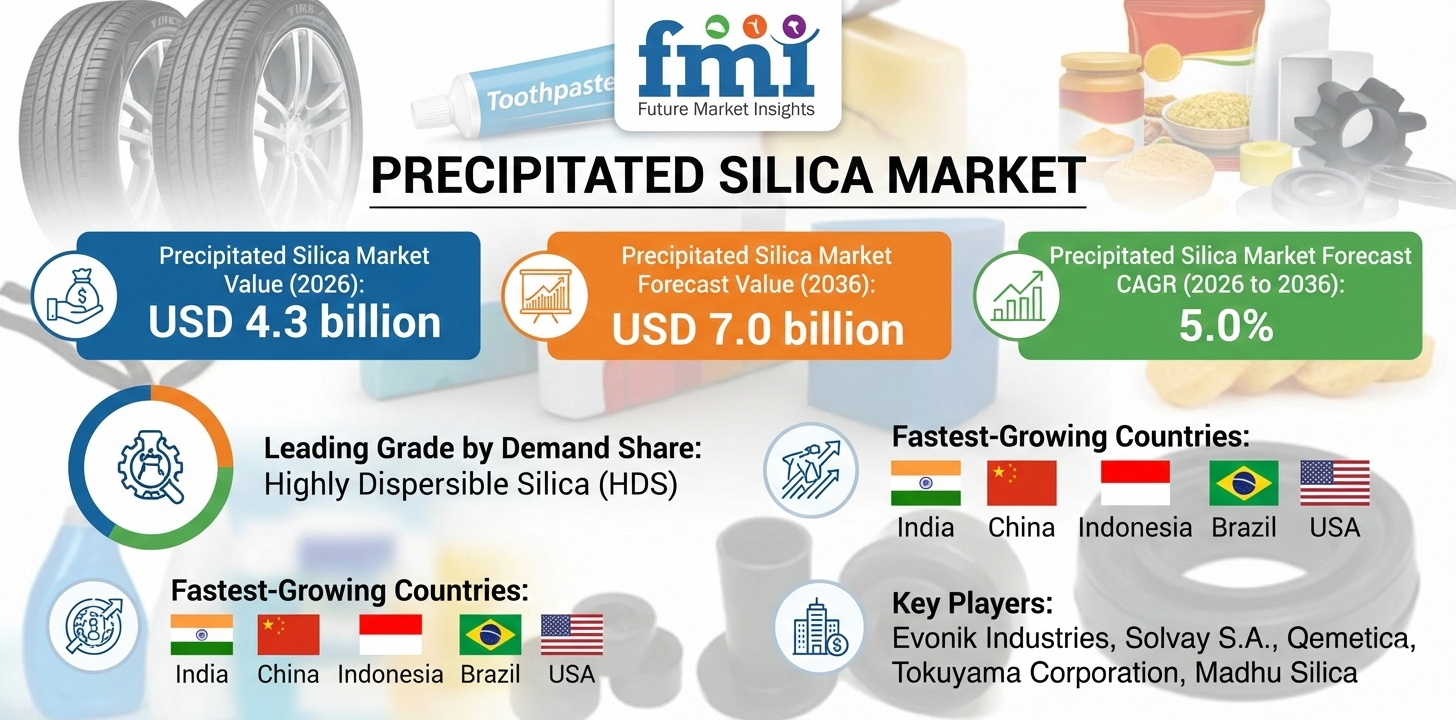
NEWARK, DELAWARE / ACCESS Newswire / February 12, 2026 / The global Precipitated Silica Market is valued at USD 4.3 billion in 2026 and is projected to reach USD 7.0 billion by 2036, expanding at a CAGR of 5.0%. according to the latest analysis by Future Market Insights (FMI). Growth reflects precipitated silica's role as a performance-critical material rather than a commodity filler. In tire compounds, precipitated silica directly influences rolling resistance, wet grip, and wear behavior, supporting fuel-efficiency targets and regulatory pressure on emissions. Beyond mobility, steady demand comes from oral care, personal care, coatings, adhesives, and specialty industrial formulations where silica functions as a controlled abrasive, thickener, matting agent, and absorbent.
Market expansion is reinforced by diversification across end uses rather than dependence on a single sector. Value concentration remains highest in applications where dispersion quality, surface area control, and structural consistency translate into measurable product performance.
Precipitated Silica Market Snapshot (2026-2036)
Market size in 2026: USD 4.3 billion
Market size in 2036: USD 7.0 billion
CAGR (2026-2036): 5.0%
Leading grade segment: Highly Dispersible Silica (HDS)
Top application: Tires & rubber (around 57.0% share)
Fastest-growing countries: India (7.0% CAGR), followed by China (6.3%) and Indonesia (6.0%)
Market Momentum
The Precipitated Silica Market begins at USD 4.3 billion in 2026 and advances steadily throughout the forecast period. By 2028, demand reflects continued growth in tire manufacturing and replacement markets, supported by adoption of silica-filled tread compounds. Entering 2030 and 2031, oral care consumption and coatings applications reinforce volume stability, while specialty grades gain traction in adhesives and industrial formulations. By 2033, expanding automotive production in Asia and increased focus on fuel efficiency sustain momentum. Ultimately, the Market reaches USD 7.0 billion by 2036, maintaining its 5.0% CAGR trajectory over the decade.
Why the Market is Growing
The Precipitated Silica Market is expanding due to increasing adoption in energy-efficient tires, rising demand from oral and personal care products, and broader use in coatings, adhesives, and industrial rubber goods. In tire applications, precipitated silica improves abrasion resistance, wet traction, and rolling efficiency, supporting OEM and regulatory performance requirements.
Growth is also shaped by how precisely silica grades are engineered and qualified within formulations. Manufacturers increasingly specify grades based on dispersion behavior, rheology response, or purity thresholds rather than relying on interchangeable commodity materials. This favors suppliers with tight control over precipitation chemistry, particle morphology, and batch-to-batch consistency.
Regulatory scrutiny around product safety, particulate handling, and permissible exposure strengthens preference for compliant, well-documented grades, particularly in food, oral, and personal care uses. While cost sensitivity remains relevant, substitution pressure is limited where silica directly affects functional outcomes. Market quality is therefore anchored in performance validation, formulation stability, and long-term supply reliability.
Segment Spotlight
1) Grade: Highly Dispersible Silica Leads with 46.0% Share
Highly dispersible silica (HDS) represents approximately 46.0% of total demand, reflecting its critical role in advanced rubber compounding for low-rolling-resistance and fuel-efficient tires. HDS grades offer superior dispersion within elastomer matrices, enabling improved traction, reduced heat buildup, and enhanced wear performance. Conventional precipitated silica supports cost-sensitive industrial applications, while specialty oral-grade silica forms a smaller but high-value segment characterized by stringent purity and particle size control
2) Application: Tires & Rubber Anchor Demand at 57.0%
Tires and rubber applications account for around 57.0% of market consumption, underscoring precipitated silica's central role in modern tread formulations. Use in passenger and commercial vehicle tires supports regulatory and OEM-driven requirements for lower emissions and improved wet grip. Oral care represents a structurally important secondary segment, where silica serves as a controlled abrasive and thickener in toothpaste. Coatings, inks, adhesives, and sealants rely on silica for viscosity control, anti-settling behavior, and mechanical stability.
3) Market Structure: Performance-Driven Formulation Selection
Market structure reflects differentiation by surface area, dispersion behavior, and purity rather than volume alone. Product selection is closely tied to end-use performance targets such as rolling resistance in tires, abrasion control in toothpaste, or rheology adjustment in coatings. Value concentration remains higher in grades delivering measurable performance gains rather than commodity substitution.
Drivers, Opportunities, Trends, Challenges
Drivers: Expansion of tire manufacturing, replacement tire demand, growth in oral care consumption, and increasing use of silica in coatings and adhesives drive steady market expansion.
Opportunities: Growth in green tires, lightweight composites, and specialty formulations creates demand for tailored silica grades with controlled microstructure and dispersion efficiency.
Trends: Rising adoption of highly dispersible silica, replacement of carbon black in selected rubber compounds, and increased specification of application-specific grades highlight the shift toward performance-led material selection.
Challenges: Energy-intensive production, raw material price volatility, regulatory requirements for particulate handling, and the need for consistent dispersion within complex formulations constrain scalability. Environmental and worker safety standards add further compliance costs.
Country Growth Outlook (CAGR 2026-2036)
Country |
CAGR |
India |
7.00% |
China |
6.30% |
Indonesia |
6.00% |
Brazil |
4.10% |
USA |
3.10% |
India leads global growth at 7.0%, supported by expansion of tire manufacturing, industrial rubber goods, and domestic silica production. China follows at 6.3%, driven by large-scale automotive, footwear, and oral care manufacturing. Indonesia records strong growth at 6.0% due to rising rubber processing and downstream industrial development. The USA reflects a mature market with incremental growth focused on specialty and reformulation-driven applications.
Competitive Landscape
The Precipitated Silica Market is shaped by suppliers combining process control, grade consistency, and application-specific performance. Competition centers on dispersion behavior, surface area management, purity, and reliable global capacity.
Vendors differentiate through tailored silica grades for green tires and oral care, compliance with food and personal care regulations, and technical service support for complex formulations. Competitive advantage increasingly depends on precipitation chemistry expertise, batch-to-batch consistency, and long-term supply reliability across global end-use industries.
Key Players in the Precipitated Silica Market
Evonik Industries
Solvay S.A.
Qemetica (PQ Silicas)
Tokuyama Corporation
Madhu Silica
For an in-depth analysis of evolving formulation trends and to access the complete strategic outlook for the Precipitated Silica Market through 2036, visit the official report page at: https://www.futuremarketinsights.com/reports/precipitated-silica-market
Related Reports:
Silica Sand for Glass Making Market: https://www.futuremarketinsights.com/reports/silica-sand-market-for-glass-making
Silica Market: https://www.futuremarketinsights.com/reports/silica-market
Silica Flour Market: https://www.futuremarketinsights.com/reports/silica-flour-market
Precipitated Barium Sulphate Market: https://www.futuremarketinsights.com/reports/precipitated-barium-sulphate-market
Silica for S-SBR Market: https://www.futuremarketinsights.com/reports/silica-for-s-sbr-market
About Future Market Insights (FMI)
Future Market Insights (FMI) is a leading provider of market intelligence and consulting services, serving clients in over 150 countries. Headquartered in Delaware, USA, with a global delivery center in India and offices in the UK and UAE, FMI delivers actionable insights to businesses across industries including automotive, technology, consumer products, manufacturing, energy, and chemicals.
An ESOMAR-certified research organization, FMI provides custom and syndicated market reports and consulting services, supporting both Fortune 1,000 companies and SMEs. Its team of 300+ experienced analysts ensures credible, data-driven insights to help clients navigate global markets and identify growth opportunities.
For Press & Corporate Inquiries
Rahul Singh
AVP - Marketing and Growth Strategy
Future Market Insights, Inc.
+91 8600020075
For Sales - sales@futuremarketinsights.com
For Media - Rahul.singh@futuremarketinsights.com
For web - https://www.futuremarketinsights.com/
SOURCE: Future Market Insights, Inc.
View the original press release on ACCESS Newswire