As one of the contributing authors, Ningbo VICH. participated in the revision process alongside industry experts, research institutions, and leading enterprises.

China's foundry industry is an indispensable pillar of the national economy and a cornerstone of strategic development. With the deepening of economic globalization and accelerated industrial transformation, the previous mandatory national standard could no longer fully meet the demands of high-quality development in the new era. To better align with current technological advancements and industry needs, the "Foundry Machinery-Safety Requirements" standard was revised and officially released in 2025.
Below, let's explore the key updates in the revised standard.
1. Revised "Scope"
The updated standard specifies the three core components of safety requirements:
General requirements
Common requirements
Specific requirements for specialized equipment
It also clarifies that the scope is strictly limited to the manufacturing phase.
2. New Section: "Terms and Definitions"
The revised standard introduces a dedicated section for "Terms and Definitions," systematically defining 10 key terms such as "hazard" and "audible and visual alarm signals." It also clearly categorizes major types of foundry machinery (e.g., sand preparation equipment, molding and core-making equipment).
3. New Section: "General Requirements"
A new "General Requirements" section mandates that manufacturers must:
Conduct risk assessments for their products.
Prioritize inherently safe design measures, followed by protective safeguards, supplementary protective measures, and usage instructions to eliminate hazards and mitigate risks.
4. New Section: "Common Requirements"
This section consolidates and enhances the technical content from the 2007 version while introducing new/modified clauses.
Compared to the 2007 edition, where general safety requirements were scattered, the 2025 version optimizes the structure with a dedicated "Common Requirements" chapter. Key updates include:
New safety regulations, such as requirements for foundry robot systems, fixed facility access, and enhanced fire/explosion prevention measures.
Stricter technical specifications, including emergency stop device standards, clamping mechanism fail-safe performance, electrical equipment protection ratings, and high-temperature resistance requirements.
5. New Section: "Specific Requirements for Specialized Equipment"
The 2007 standard lacked detailed safety regulations for different types of foundry machinery. The 2025 edition addresses this gap with a dedicated chapter covering 12 major categories, such as:
Sand preparation and reclamation
Molding and core-making
Knockout and core removal
Investment casting, lost foam casting
Die-casting and squeeze casting units
Low-pressure, differential-pressure, and gravity casting
Centrifugal casting
Cupola furnaces and melting systems
Ladles and pouring systems
Shot/sand blasting and cleaning
Cutting and grinding of castings
Each category addresses unique hazards and risk points.
VICHNET's Contribution
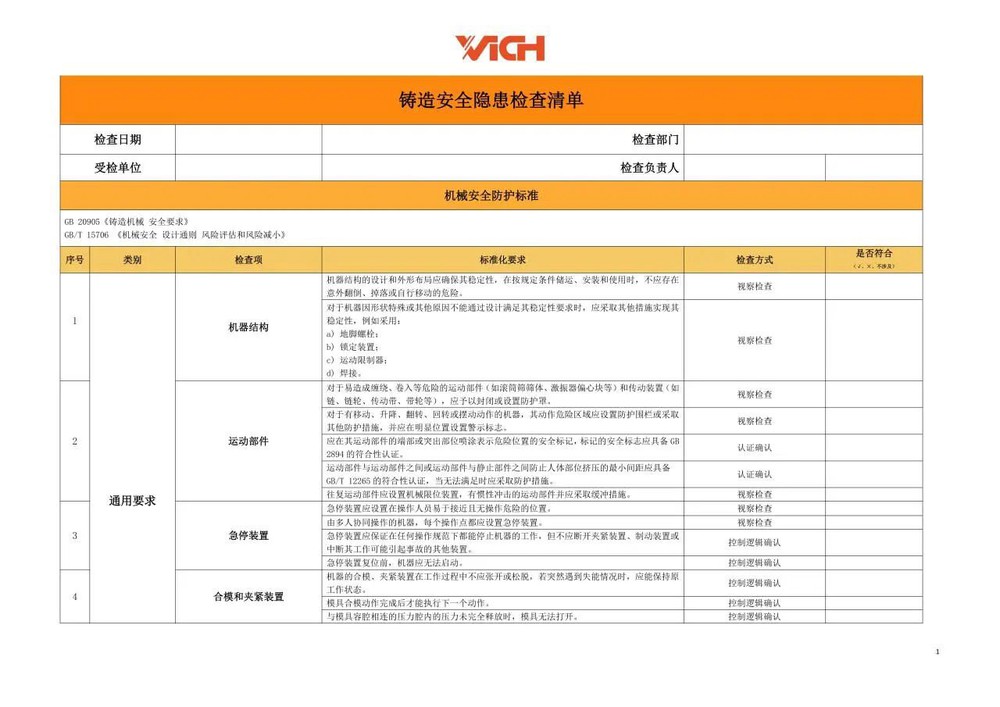
As a co-author of GB 20950-2025, Winchen Technology not only participated in the revision but also developed a practical inspection checklist to translate the standard into actionable steps for enterprises. This tool simplifies compliance by breaking down abstract clauses into clear, executable items.
The checklist is publicly available in the appendix and on Winchen's EHStools platform-a professional, agile tool for machinery safety assessments. The platform offers:
Template library for safety inspection forms (editable, importable, and exportable).
Industry-specific safety standards (accessible to professional users).
Online consultation with CMSE-certified safety experts for real-time support.

Tailored Safety Solutions for Foundries
Recognizing the high-risk nature of foundries, Winchen provides targeted safety solutions, including:
Physical barriers integrated with warning lights, safety door switches, and control units for intelligent hazard prevention.
Comprehensive protection to ensure personnel safety and equipment uptime.

Commitment to Standardization
Contributing to GB 20950-2025 is just one example of Winchen's dedication to national standardization. We have actively participated in drafting and revising multiple national, industry, and group standards. Recently, Winchen co-authored two additional national standards:
GB/T 30174-2025 "Mechanical Safety-Terminology"
GB/T 16855.1-2025 "Mechanical Safety-Safety Control Systems-Part 1: General Principles for Design"
Guided by our mission-"Leading Industry Progress, Empowering Shared Success"-we believe that active participation in standardization fosters technological exchange, drives sustainable growth in manufacturing, and helps every stakeholder achieve their aspirations.
Media Contact
Company Name: Ningbo Cnvich Import and Export Co., Ltd.
Email: Send Email
Country: China
Website: https://www.nbvich.com/